Aluminum parts can leave wet mass finishing with a dull film or develop spots as rinse water and compound residue dry on the surface. Start by finding when the discoloration appears: after finishing, after rinsing, or after drying. Then check the conditions at that stage. A stain alone does not tell you that the media is wrong, that the part is corroded, or that a longer cycle will fix it.
The useful first question is simple: Was the part already marked when it came out, or did the mark appear later?
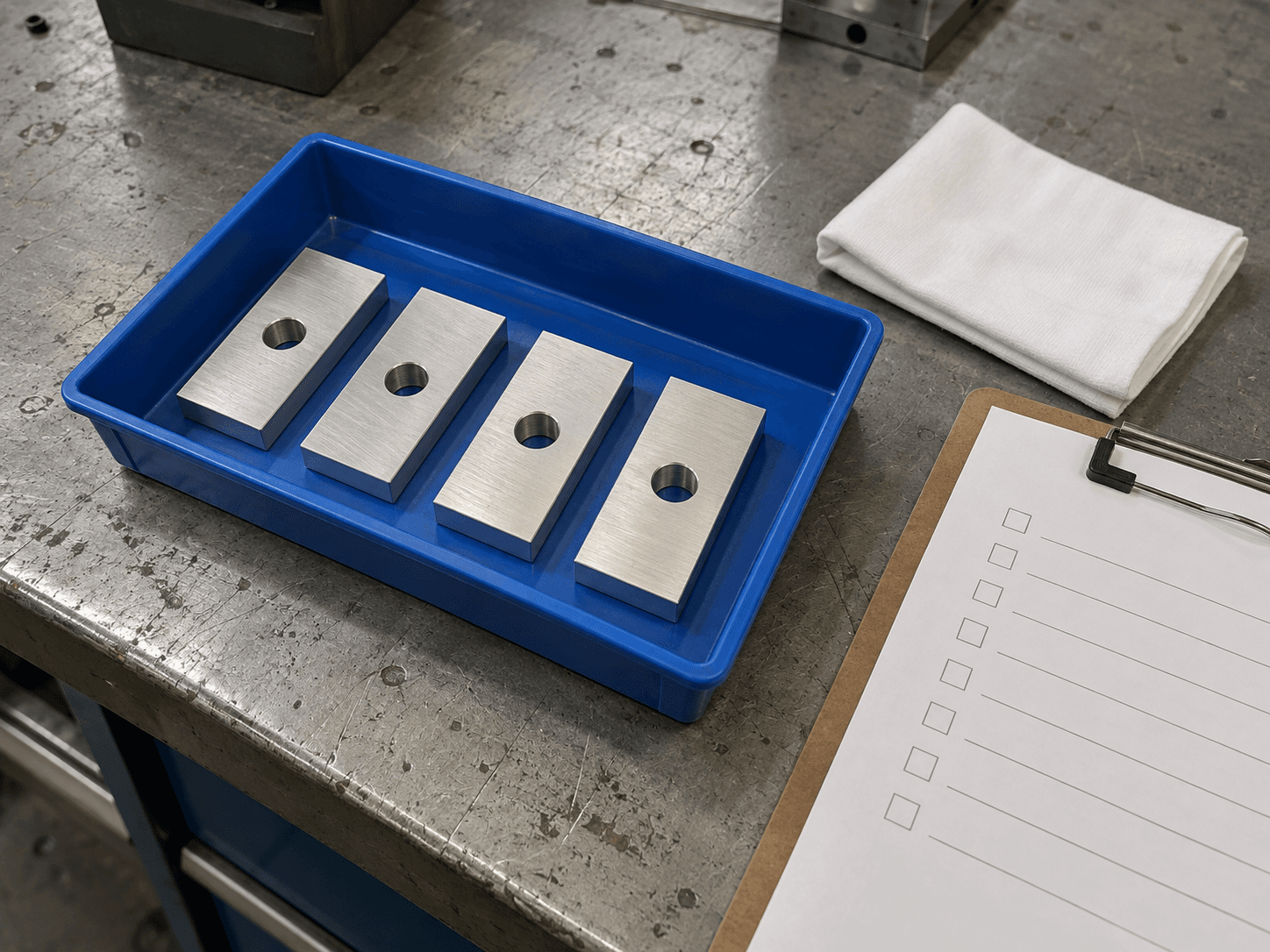
AI-generated conceptual illustration: generic aluminum coupons, a cloth and a blank checklist on a workshop bench. Not a Richwood product, customer part, defect example or measured finishing trial.
Start with the part and the accepted finish
Record the aluminum alloy, the incoming surface condition, the finishing machine and the required appearance. Keep an unfinished reference and an accepted finished reference. A matte surface may be acceptable on one job and unacceptable on another; “make it shiny” is not a complete acceptance requirement.
If anodizing or another coating follows, include that next operation in the discussion. A visually improved part still needs to meet the coating shop's preparation requirements. See our guide to deburring before anodizing aluminum.
Keep questionable pieces separate from accepted production. Photograph them under the same lighting and note when each image was taken. Different lighting can make a surface comparison harder to interpret.
Find the first stage where the mark appears
Use a small, controlled check under your normal inspection procedure. Follow the machine's instructions for safe sampling; do not reach into moving equipment.
| First observation | What to check next | What it does not prove |
|---|---|---|
| Dull film is present as parts leave the finishing stage | Incoming contamination, process-water condition, media cleanliness, and the actual compound and dose | That a more aggressive media grade is needed |
| Marks remain after the rinse | Rinse cleanliness, coverage, trapped liquid, and whether compound residue is being removed | That the stain is corrosion |
| Spots appear only as parts dry | Water quality, retained droplets, delay before drying, and the drying process | That extra finishing time will help |
| The problem affects only certain features or only part of the load | Where liquid collects, part orientation, and differences between affected and unaffected pieces | That every part needs the same corrective action |
This is a way to narrow the investigation, not a visual diagnosis of surface chemistry. Record the first point where the problem is visible before changing the process.
Check water and compound before buying different media
Wet finishing uses a process system: parts, media, water and compound. Dirty process water can leave a dull film on aluminum. Inadequate rinsing can leave compound residue; water evaporating from the surface can leave visible deposits.
Check the product name and the measured operating dose against the supplier's instructions for that alloy and application. Do not assume that a pump setting proves the delivered dose. Keep water-flow and rinse conditions in the same record.
Do not add acid, alkali or a different cleaner based on the color of a stain. Confirm compatibility and a proposed correction with the process supplier. There is no universal pH, concentration or rinse time that this article can prescribe for every aluminum part.
For the broader selection questions, use our mass-finishing compound guide.
If the marks appear during drying, inspect that handoff
A part that looks acceptable while wet may show spots after the remaining liquid evaporates. Check whether parts sit wet in a tray, whether recesses retain liquid, and whether the drying method reaches those areas.
Where drying media is used, inspect its condition as well. Moisture and accumulated residue can make it less effective. Choose a drying method around the part's geometry and handling limits rather than assuming every aluminum part belongs in the same dryer.
Our guide to drying after wet mass finishing covers that equipment decision. Here, the goal is to establish whether the visible problem begins at the drying stage.
Test one correction and inspect the complete result
Once the likely stage is identified, agree on one controlled change. Keep the remaining conditions documented so the result is interpretable. Inspect after the full finishing, rinsing and drying sequence, not just while the part is wet.
Compare appearance with the accepted reference and check the job's required edges, dimensions and surface finish. Do not run production longer simply because a stain remains. Removing more material is not a substitute for identifying residue or a rinse-and-dry problem.
If the mark persists, do not guess at its chemistry from a photograph. Give the process supplier affected and unaffected examples, the alloy, the product identities and the stage observations. Further evaluation may be needed before deciding whether the parts can be reworked or accepted.
What to send when asking for help
A useful inquiry includes:
- The alloy and an image of the unfinished and accepted finished surfaces.
- The machine, media identity and compound identity, plus actual operating conditions.
- Photos showing the first stage where the mark appears.
- Rinse-water and drying details, including any waiting time between stages.
- The acceptance requirement and any following coating operation.
Contact Richwood about the finishing problem. Start with the part and the required result, then discuss whether a representative sample evaluation is the right next step.