Bring outsourced deburring in-house when a proven process can meet the part requirements, your actual workload supports it, and the complete cost and production plan make sense. Start with one recurring part family—not the total amount your shop spends on outside finishing.
Which parts would move? What does the outside supplier actually do to them? Who will load, separate, clean and inspect them in your shop?
Those answers matter more than a fast machine demonstration. You may find a good case for moving one job in-house while keeping specialty or overflow work outside.
First, match the work you are comparing
Pull the purchase order, drawing and finishing requirements for one repeat job. Identify the operations included in the supplier's price. Deburring may be only one step in a route that also includes cleaning, a specified treatment, inspection or packaging.
Do not compare that complete outside route with an in-house quote that covers only burr removal. List what would remain outside and what would become your responsibility. Preserve required approvals and documentation; a new machine does not waive a customer's process requirements.
Keep the comparison tied to the same material, incoming burr condition, accepted finish and usable quantity. A better-looking sample is not a like-for-like result if a critical fit no longer passes.
Prove the part before counting savings
A centrifugal barrel process can be a candidate for batch deburring, but one successful part does not establish the production load. The media, compound, settings and handling method must fit the application. Do not assume a machine or recipe qualified for another job will transfer unchanged.
Agree on acceptance before a trial: the burr to remove, edges and dimensions to preserve, appearance, any specified surface roughness, and the condition required by the next operation. Use representative unfinished parts, including the incoming variation the process must handle—not only the easiest pieces.
Check the actual load through unloading, media removal, cleaning or drying where needed, and inspection. Stay within the machine manufacturer's operating limits. Machine capacity is not simply the number of parts that physically fit.
If the proposed process fails an acceptance check, resolve that before using its cycle time in the buying decision. A fast reject is not savings.
Put the full route on one sheet
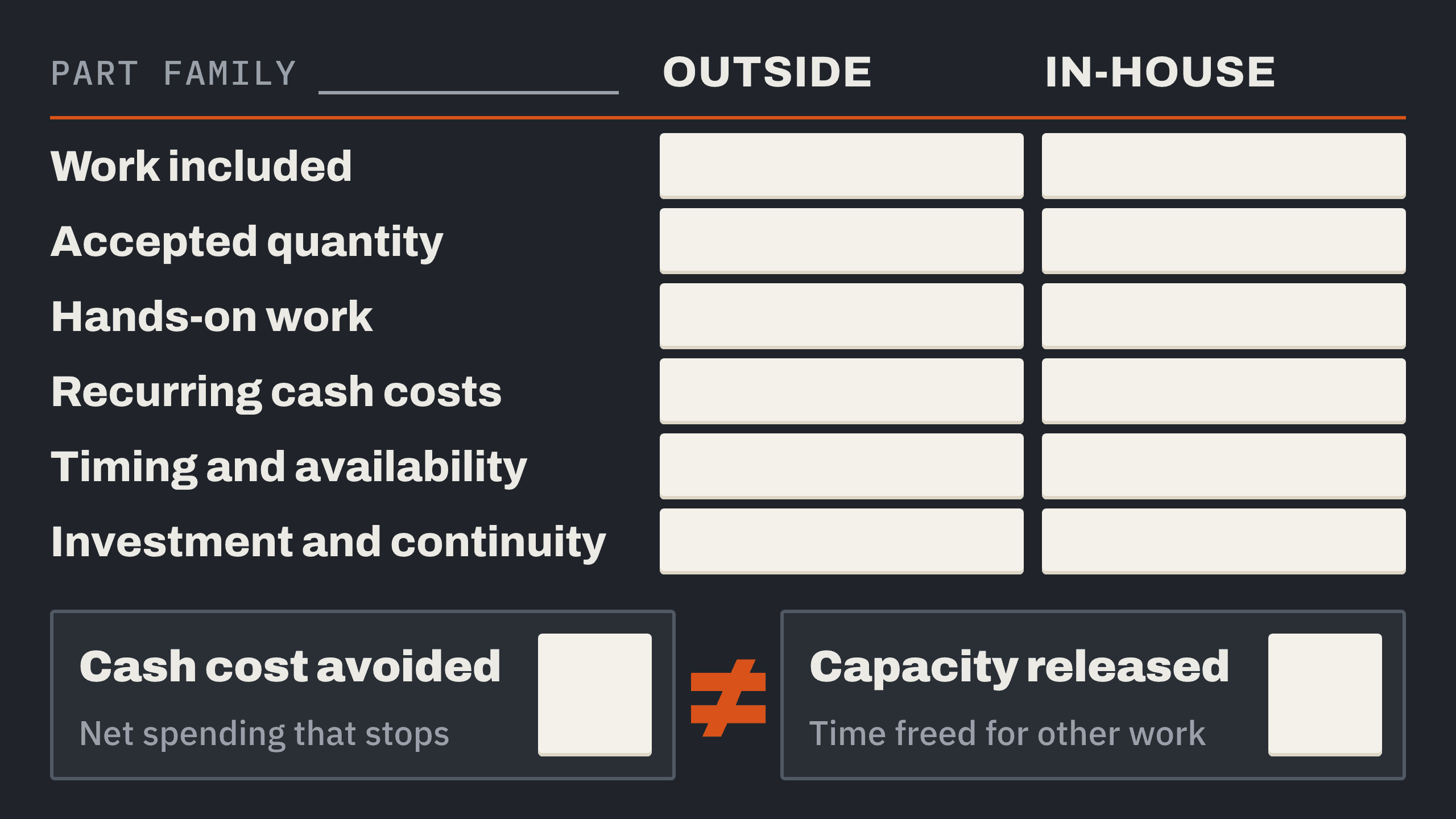
Use this blank worksheet for the selected part family. Choose the same comparison period and accepted quantity for both routes. Mark an unknown as not measured, rather than entering zero.
| Decision input | Current outside route | Proposed in-house route |
|---|---|---|
| Work included | Supplier operations, inspection, packaging and exclusions | Operations proved by trial; remaining outside work and exclusions |
| Accepted quantity and demand | Accepted parts received; repeat orders supported by records | Accepted output demonstrated; realistic orders allocated to this setup |
| Hands-on work | Packing, shipping preparation, receiving and incoming checks | Setup, loading, unloading, separation, cleaning, inspection and reset |
| Recurring cash costs | Supplier charges, transport and attributable rework costs | Consumables, utilities, maintenance, waste handling, added labor and remaining outside charges |
| Timing and availability | Transport, supplier queue, processing and receipt-to-release time | Queue, full batch route, changeovers and staffed machine availability |
| Investment and continuity | Any costs required to keep the current route | Installed equipment, startup and qualification costs; backup route during interruption |
Planning worksheet for your own records. Blank fields are not test results, quoted costs or a promise of savings. Do not put confidential drawings or customer information into a public form without your company's authorization.
Keep elapsed time and hands-on labor separate. A batch can run while an operator does other work, but someone still has to handle the steps around it. If two activities overlap, do not add both durations and call the result elapsed lead time. Our whole-batch timing guide explains what to record.
Separate released time from cash savings
If an employee stops hand-finishing or managing outside shipments and returns to machining, that time may be valuable. It does not automatically remove wages from payroll.
Keep two entries:
- Cash cost avoided: spending that will actually stop, less the additional recurring spending needed to run the in-house route.
- Capacity released: documented time available for other work, with a realistic use for that time.
Do not count the same labor twice—as reduced payroll and as extra production value. Similarly, a shorter lead time can help scheduling without creating an automatic dollar saving. Record the benefit and the evidence separately.
For a basic payback screen with steady annual savings starting in the first year, divide the complete installed-and-ready investment by positive annual net cash savings. Use the same currency and period throughout. If savings vary or start later, track cumulative cash flows by period instead of using that shortcut. If savings are zero or negative, the shortcut does not produce a positive payback case. It is only a screening calculation, not a financing, tax or full investment appraisal.
Ask whoever owns your budget to review the assumptions. Avoid basing the purchase on a full machine schedule that the order book does not support.
Test the quiet month, not only the busy one
A job shop's mix changes. Make a lower-volume case using a plausible order level from your own records. Include changeovers between the jobs you actually expect to schedule. Do not treat unqualified future work as committed machine utilization.
Then ask what happens if the main repeat order stops, the trained operator is unavailable, or the machine needs service. Identify a backup route and confirm its availability rather than assuming your former supplier will have immediate capacity.
The useful choices are not just “buy” or “keep outsourcing”:
- Move the qualified repeat family in-house when its quality, workload and cost evidence support the decision.
- Keep a split route when repeat work fits your setup but specialty operations or overflow still belong outside.
- Keep outsourcing for now when volume is uncertain, qualification is incomplete or the complete operating case does not support ownership.
Bring one real job to the conversation
Contact Richwood about the part family you are evaluating. Start with material, part dimensions, the burr or finish target, typical batch quantity and how often the job repeats. Identify the operations you want to bring inside and those that must stay with another provider.
Have representative unfinished parts and a finished reference available if appropriate. Agree on trial scope, acceptance checks, any fees and shipping arrangements before sending parts. The first decision is whether the proposed process fits the job. The equipment purchase comes after that proof.