Choose cutting media when the job requires abrasive material removal. Consider burnishing when the job is to smooth or brighten an already suitable surface through pressure contact. These are different actions, even when they happen in similar-looking finishing equipment. Steel media is not automatically a replacement for an abrasive deburring process—and a brighter part is not proof that its burrs are gone.
Start with the part: what needs to come off, what needs to look different, and what must stay unchanged?
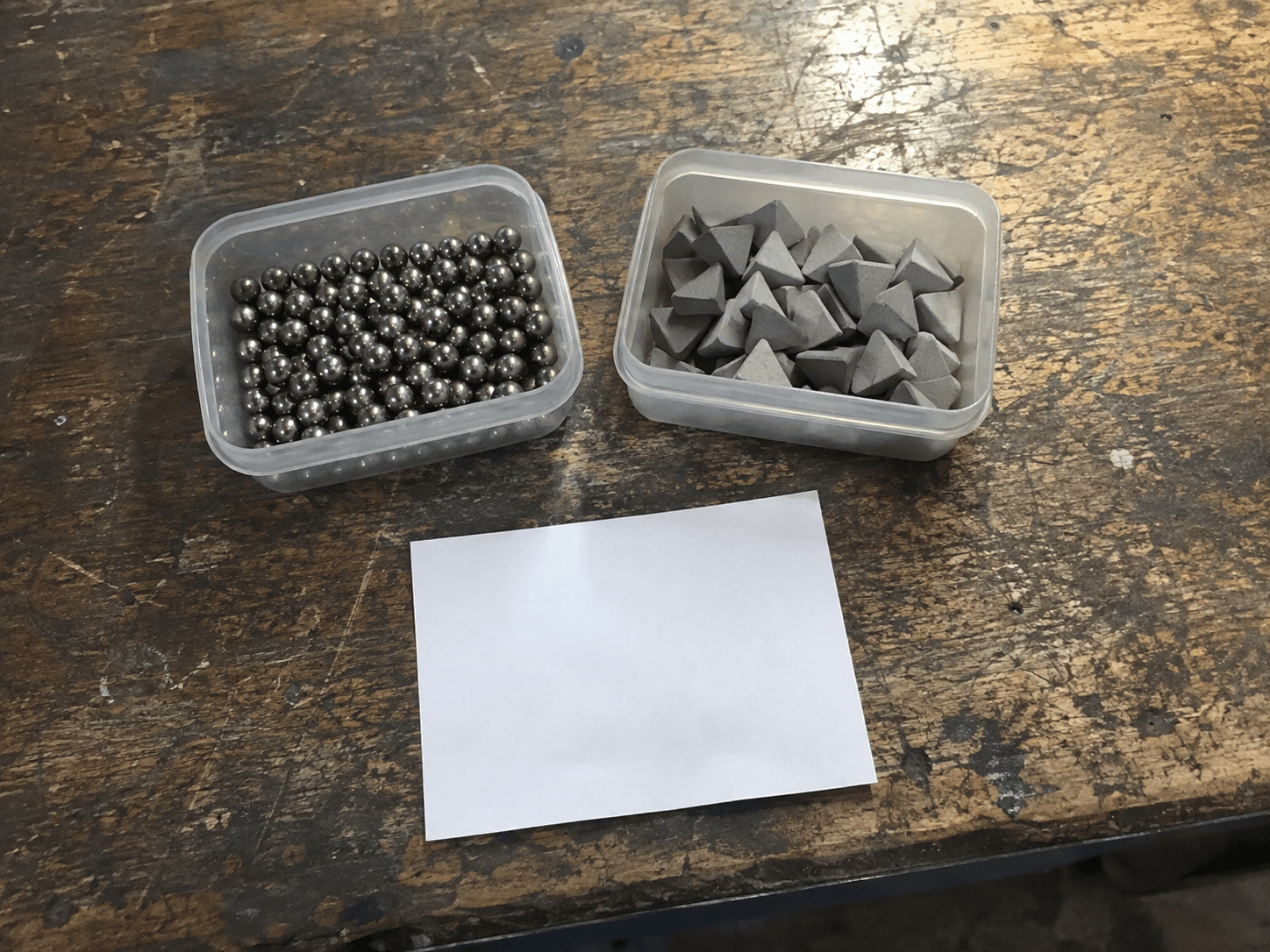
AI-generated illustration of generic steel balls and ceramic media in separate trays. Not Richwood product photography, a media recommendation, a scale reference or measured test evidence.
Cutting and burnishing do different work
In abrasive mass finishing, the machine moves parts and abrasive media against one another. That action removes material. The selected media composition, shape and size, together with the equipment, compound and operating conditions, determine whether the process addresses the required burrs and surfaces.
In ball burnishing, non-abrasive steel or stainless-steel media smooths the surface through pressure contact. Do not confuse that action with abrasive cutting simply because both can improve the appearance of a part.
There is an important exception: specially shaped steel media can be used in pressure-deburring processes to remove or minimize burrs. That does not make every steel ball a deburring tool, or every burnishing setup suitable for your burr. The media geometry and the actual process matter.
“Polishing” also needs clarification. A supplier may use the word for a fine abrasive process, a multi-step finishing sequence or a brightening result. Describe the required change instead of ordering on that word alone.
Match the request to the result
| Your request | What to establish before selecting media |
|---|---|
| Remove a machining burr | Identify its location, size and attachment, then establish how the proposed process removes it. Do not judge success by brightness. |
| Smooth or brighten a surface | Confirm the starting condition and the desired finish. Ask whether abrasive cutting, burnishing or more than one stage is appropriate. |
| Preserve a critical edge or dimension | State the allowable change and inspection method before the trial. Neither a media name nor a shiny result proves compliance. |
| Replace the current media with steel | Confirm the machine manufacturer's permitted media and load limits, the required compound and the intended process action before running it. |
A useful request is specific: “This burr must be removed, this face must match the approved reference, and this edge must remain within the drawing limit.” That gives the process supplier something to evaluate.
If you need both deburring and brightness
Do not assume one stage will achieve both requirements. Ask whether a cutting stage followed by a separate finishing stage is needed, or whether a tested single-stage process can meet the full requirement.
For a proposed sequence, inspect the parts after the burr-removal stage and again after the final stage. This helps show which operation produces each result. Keep the burr, edge, dimension and appearance checks separate. If the drawing specifies surface roughness, include that measurement too; see why a shiny part does not establish its roughness.
Include the work between stages when comparing options: unloading, media separation, cleaning, transfers and final inspection. A second stage is not just another timer setting. Its handling requirements belong in the production plan.
Three questions before changing media
- What is failing now? Show the remaining burr, unacceptable surface or other specific defect. A general request for “better polishing” can point the trial in the wrong direction.
- What is the current setup? Identify the machine, media specification, compound, operating conditions and part material. Check equipment compatibility before substituting media.
- How will the result pass? Provide the relevant drawing limits and a finished reference where useful. Agree who will inspect the trial and what evidence is needed.
If the current process removes the burr correctly but misses the desired appearance, say that. If it creates the right appearance but leaves the burr, say that instead. Those are different problems.
Can you choose from a photo?
A photo can help explain the current condition and desired appearance. It cannot establish the media's abrasive formulation, prove burr removal on a hidden feature or validate an operating recipe. Use it to start the discussion, not to approve the process.
Talk with Richwood about the part and the job the media must do. Bring the material, current setup, burr location and finish requirement. Confirm the trial scope, inspection responsibilities and commercial terms before shipping parts.