Dry tumbling is not a drop-in replacement for wet deburring. A dry polishing or drying step can serve a different purpose from a wet process that removes burrs. Before changing the route, establish what the part needs: material removal, a different appearance, removal of moisture, or some combination. Then verify that the proposed process does every required job.
Start with two questions: What does the unfinished part look like? What must an acceptable finished part look like—and measure like?
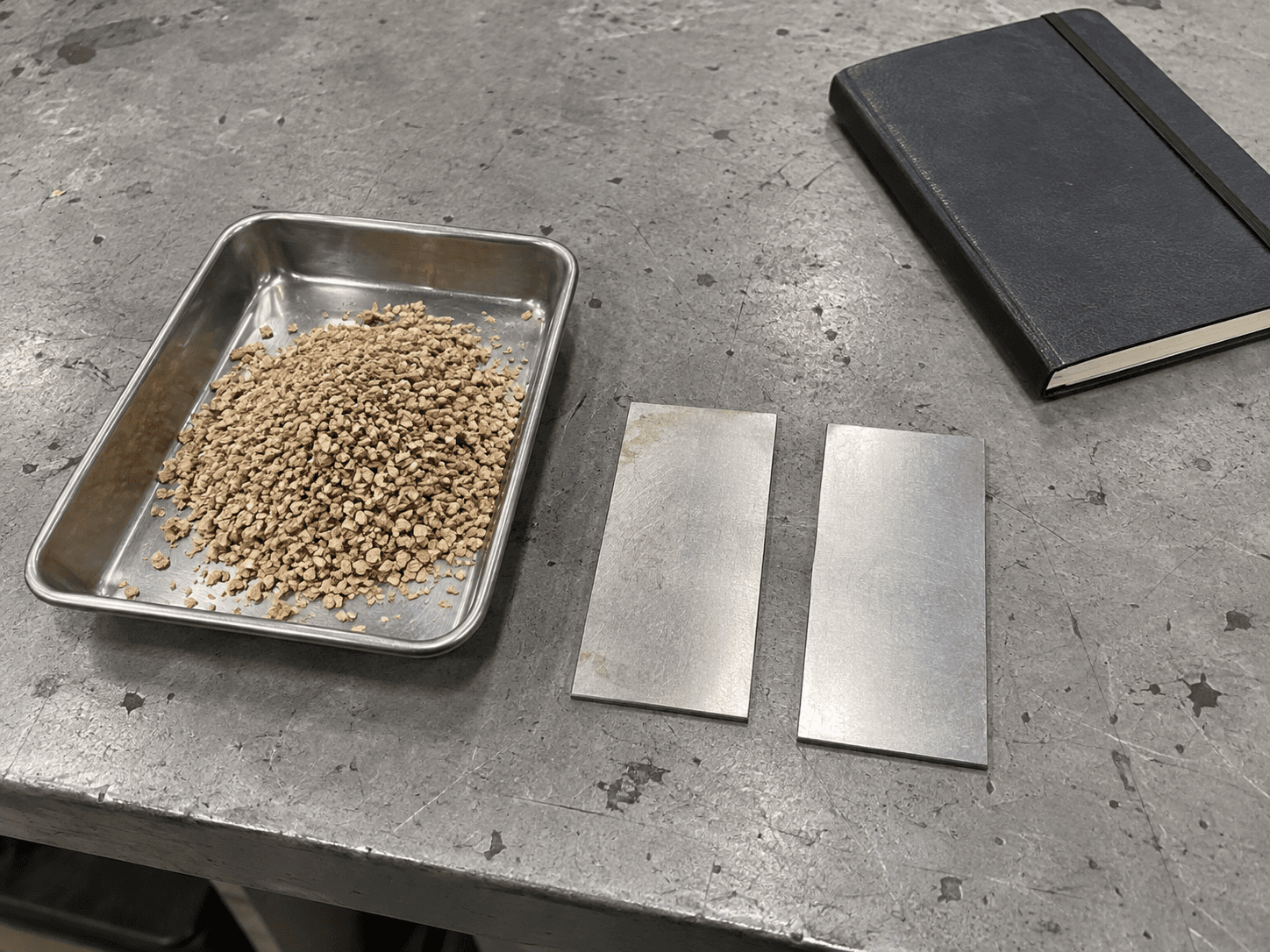
AI-generated conceptual illustration: generic dry granules and metal coupons on a workshop bench. Not Richwood products, customer parts or a measured trial. Granule appearance and quantity are not process specifications.
Dry polishing, drying and deburring are not the same job
“Dry media” does not tell you enough to select a process. Corn-cob and nutshell products can be used for drying, cleaning or polishing, depending on the product and process. A polishing application may use a specified paste. None of those descriptions, by itself, establishes that the process will remove your machining burr.
| Required job | What to establish before choosing a dry route |
|---|---|
| Remove a burr | Does the proposed process remove the actual burr while preserving the required edge and dimensions? |
| Change surface appearance | What appearance is acceptable, and are there separate roughness or dimensional requirements? |
| Dry an already-finished part | Are the part and its recesses dry, and can the drying media be completely separated? |
| Prepare for the next operation | Does the part meet that operation's cleanliness and residue requirements? |
Do not reject every dry process as incapable of material removal. Equally, do not treat a drying or polishing product as proof of deburring capability. Ask for evidence for the proposed machine, media and part combination.
Why simply stopping the water changes the process
In a wet mass-finishing process, the fluid is not just there to make the part wet. It helps carry away material removed from the parts and media and helps keep the media surface active. The compound is selected for the material and processing objective.
That means “run our wet recipe without water” is a process change, not a cleanup shortcut. Confirm with the equipment and media suppliers that the proposed dry operation is suitable. Do not assume that an existing wet machine, media charge or operating setup is approved for it.
If the real problem is the work after wet finishing, name that problem first. Is it rinsing, drying, media removal or manual handling? A separate downstream fix may be worth evaluating alongside a different finishing route. Changing the cutting process is not the only option.
Compare the complete route, not just the machine cycle
Ask the person proposing the change to show the full sequence from incoming part to accepted part. Include preparation, processing, separation, any cleaning, inspection and handling. A route described as dry does not automatically mean the finished part needs no further cleaning.
Use the same acceptance criteria for the current process and the proposed one:
- Burr and edge: Inspect the specified locations, not just the easiest outside edge.
- Dimensions and finish: Check critical features and any specified surface roughness; appearance alone is not the acceptance test.
- Cleanliness and separation: Check recesses and holes for retained media or residue before the next operation.
- Whole-route effort: Record elapsed time, hands-on time and accepted quantity. Include rework and additional cleaning if needed.
Keep the comparison tied to your actual material, geometry and production quantity. Do not turn a successful cosmetic polish on one simple part into a production claim for a different part.
What to bring to the process discussion
Bring representative unfinished parts and an accepted finished reference if one is available. Add the material, drawing requirements, burr locations, current machine and media, batch quantity, and what is making the existing route difficult.
Be specific about the target: “remove this burr without changing this fit” is more useful than “make it nicer.” If the goal is to eliminate a rinse or shorten handling, say so. That lets the discussion test the proposed benefit instead of assuming it.
For an overview of available media families, see Richwood's finishing media guide. To discuss the part and current process, contact Richwood. Ask which route is worth evaluating before choosing a different bag of media.
Quick answers
Can corn cob replace my cutting media?
Do not assume so. Corn-cob products have drying, cleaning and polishing uses. That does not establish that a particular product will remove your burr. Confirm the intended application and compare the resulting part against your requirements.
Does a dry route eliminate every cleaning step?
Not necessarily. The next operation still sets the cleanliness requirement. Verify residue and retained media rather than inferring cleanliness from the absence of process water.
Is dry tumbling always cheaper?
No general cost conclusion follows from the word “dry.” Compare total handling and processing cost against accepted output, including any extra cleaning or rework. This article makes no cost or cycle-time promise.