

Yes, process water from wet mass finishing can often be treated and reused. But the right system depends on what is in the water, what the finishing process needs, and where the water will go next. Removing visible solids is not, by itself, proof that the water is ready for reuse or sewer discharge.
Start with two questions: What are you finishing, and what do you need this water to do next? Returning water to a deburring machine is a different decision from meeting a final-rinse requirement or an authorized discharge limit.
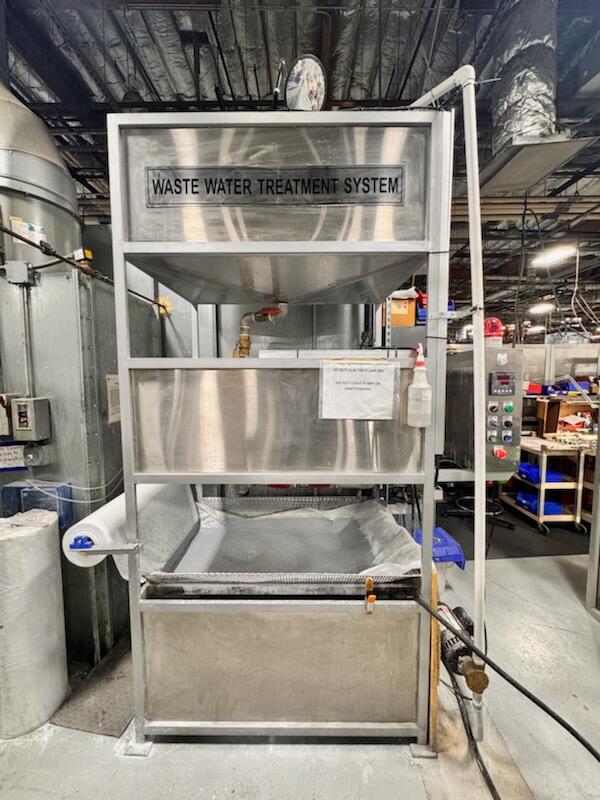
Actual WW 200 equipment photograph from Richwood’s approved website assets. The photo illustrates equipment layout, not water quality, a customer result, or treatment performance.
Separate the three decisions
| Decision | What to establish before buying |
|---|---|
| Reuse in the finishing machine | Will the treated fluid work with the selected compound and keep the required part finish consistent? |
| Use for a rinse | What cleanliness requirement does the next operation need, and how will you verify it? |
| Discharge to a sewer | What requirements apply at your facility, and what testing or authorization does the local wastewater authority require? |
The water may look better after treatment. Appearance alone does not answer these questions.
Solids separation and chemical treatment are not the same thing
Rösler describes its process-water centrifuges as systems that separate solids generated during mass finishing so the fluid can be reused. Centrifugal force separates solids from liquid; the manufacturer also describes process-water cleaners and additives used to support the application.
Richwood’s WW 55 wastewater recycling system uses chemical precipitation. Its published applications include deburring and rinse waters. Chemical precipitation is a different treatment approach from simply separating suspended particles by centrifugal force.
Do not choose between them on tank size alone. Ask the supplier to explain what the proposed process addresses, what remains in the treated fluid, and how the result will be checked using your actual water. Equipment labeled “recycling” is not a universal recipe for every combination of metal, media, compound, and contamination.
Bring a process description before asking for a machine recommendation
A useful starting brief includes:
- Parts and materials: what metals you run, whether materials change between batches, and the finish you need.
- Current chemistry: compound names, available safety data sheets, and any cleaners or oils that may enter the stream.
- Water volume and timing: an estimate per shift, plus whether water arrives continuously or in intermittent dumps.
- Separate streams: distinguish finishing water from rinses and other shop wastewater rather than assuming they can all use one treatment approach.
- Destination: machine reuse, a particular rinse stage, or a permitted discharge route.
- Operating constraints: space, operator involvement, maintenance, and handling of the separated sludge.
These are questions for selecting and evaluating a process, not instructions to mix chemicals or collect a sample without supplier guidance. Ask what information and sampling procedure the supplier needs first.
Prove the water loop and the finished part together
Agree on acceptance criteria before evaluating treatment. For reuse, check both the treated fluid and the parts produced with it: the required edge condition, surface appearance, and cleanliness still need to be met. Record the process conditions so an acceptable result can be evaluated for repeatability.
Include work outside the treatment cycle. Who removes sludge? What consumables need replacement? How much operator time does the full routine require? A water-reuse proposal should describe these tasks, not just the equipment’s nominal capacity.
For sewer discharge, use the applicable requirements rather than the color of the water or a generic equipment claim. The EPA’s National Pretreatment Program explains the federal, state, and local roles governing industrial discharges to municipal wastewater systems. Confirm your facility’s requirements with the responsible authority; a treatment machine does not establish discharge permission.
Where should you start?
Start with your part, existing finishing process, and intended water destination. Then select a treatment approach that can be evaluated against those needs.
Talk with Richwood about your process-water application. Bring the material, current compound, estimated water volume, and reuse or discharge goal. Confirm application fit and the evaluation scope before selecting equipment.