
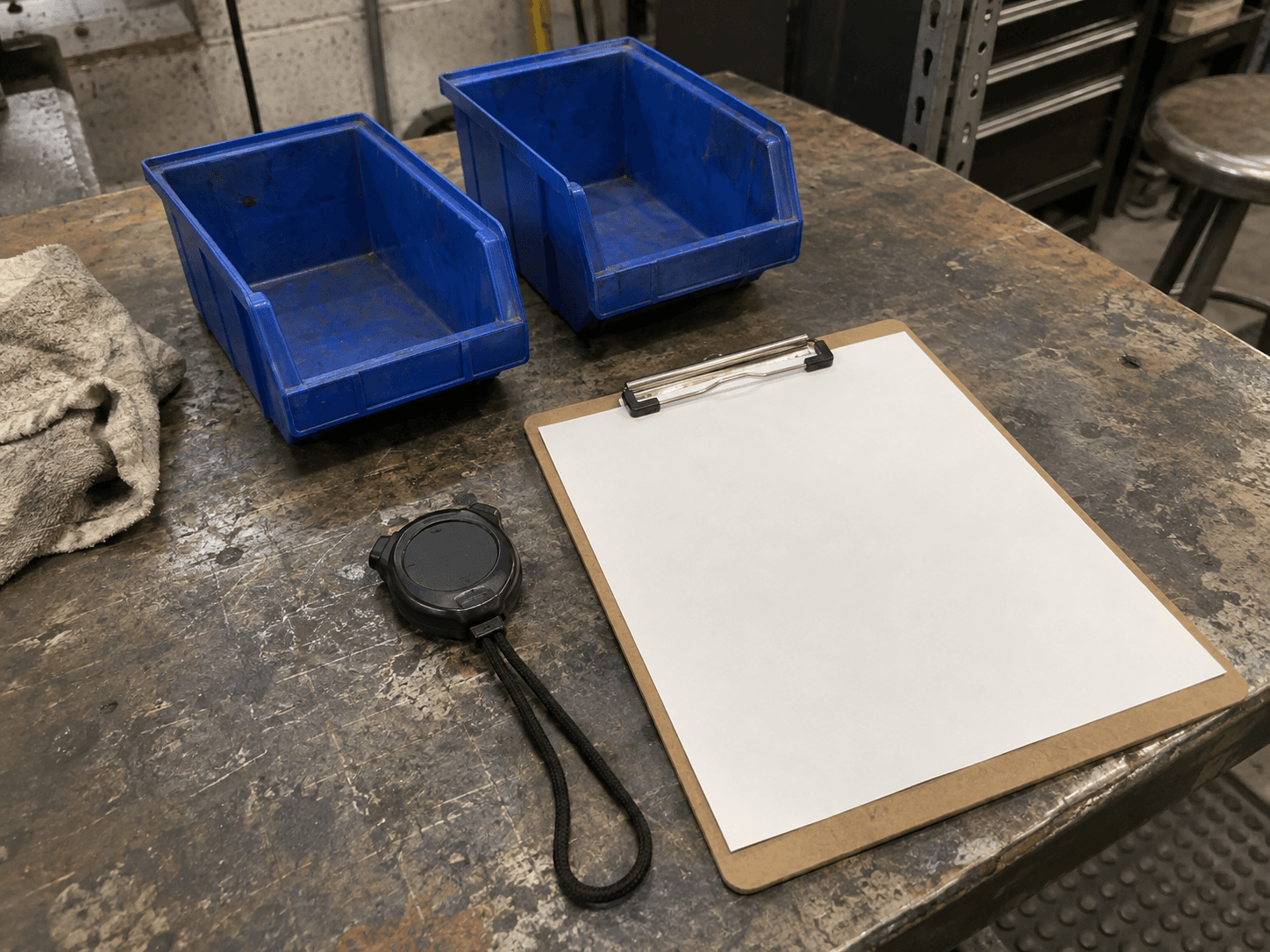
A shorter finishing cycle improves output only if the rest of the process can keep up. Before changing a proven recipe or buying more capacity, time one batch from loading through separation, rinsing, drying, and inspection. Record hands-on labor separately from elapsed time, and count accepted parts—not just parts unloaded.
At IMTS 2026, the organizer describes its Emerging Technology Center as a live, end-to-end manufacturing system. That is a useful way to look at your finishing area, too: the machine is one step, not the whole route. This is a production-checking exercise, not a claim about results at the show or Richwood's participation.
Start with the part—and the queue
What part are you running? What finish does it need? Where does the batch wait after the machine stops?
Pick a representative production batch. Write down the material, part geometry, incoming burr condition, machine, media, compound, load, and finish requirements. Keep that information with the timing sheet. Otherwise, a faster batch might simply be an easier batch.
Agree on acceptance before the run: burr removal, permitted edge change, critical dimensions, appearance, and any specified surface roughness. A smooth-looking part is not automatically an accepted part.
For background on time inside the barrel, see our centrifugal barrel cycle-time guide. Here, the question is what happens around that cycle.
Follow one batch all the way through
Use start and finish times for each step. Beside them, record the minutes an operator actually spends working on that batch.
| Step | What to record | Question to investigate |
|---|---|---|
| Stage and load | Waiting time, setup, loading, part count | Are parts and consumables ready when the machine is available? |
| Run | Machine start/stop and interruptions | Does the established process meet the finish requirement? |
| Unload and separate | Handling time, sorting, trapped media checks | Is separation holding up the next load? |
| Rinse and dry, where required | Transfers, queue, processing time | Can the next operation accept the parts in their present condition? |
| Inspect and release | Inspection queue, accepted count, rework | How many parts are ready for the next operation? |
| Reset | Cleanup and preparation for the next batch | When is the finishing station ready again? |
Observe normal production without interrupting safe operation. Follow the machine's operating instructions; never open or reach into running equipment to collect a timing.
Separation deserves its own line
Media separation means removing the finishing media from the parts after processing. It is not necessarily instantaneous, and an attractive finish does not tell you how easily the load separates.
MFI's PV separator documentation describes replaceable screens and a system in which media passes through while parts remain above. That is an example of purpose-built separation equipment, not a claim that this particular separator fits a Richwood machine or your application.
Check the actual combination of part, media, and separation method. Does media remain in holes or slots? Does someone sort the load by hand? Does unloading tie up the machine or operator needed for the next batch? Record those observations before recommending different equipment or media.
Drying is a process choice, not an afterthought
For a wet process, establish the condition the next operation requires. Rösler's dryer guidance describes both batch and continuous systems and notes that sensitive parts and deep, small bores can affect dryer selection, including the risk of drying media becoming stuck.
That does not mean every part needs the same dryer—or a dryer at all. It means the drying method should fit the material, geometry, cleanliness requirement, and downstream operation. Include any required rinse and dry steps in the trial and production timing, not just the cutting cycle.
Keep three measurements separate
Batch lead time: elapsed time from the chosen starting point to release of that batch. State whether the measurement includes queues.
Hands-on labor: the sum of operator time spent on the batch. Two people working for ten minutes is twenty labor-minutes, even though only ten minutes elapsed.
Accepted output: parts released to the next operation during a defined observation period, such as a shift. Count rejects and rework separately. Do not count a reworked part twice.
Do not add overlapping steps and call the sum elapsed time. If one batch dries while another runs, record that overlap. Likewise, one batch's lead time does not by itself establish the station's sustained hourly capacity.
Change the constraint, then check the result
If the machine waits for unloading, investigate handling and separation. If completed batches wait for inspection, a faster finishing cycle may only enlarge that queue. If the machine itself remains the limiting step, evaluate process or capacity changes against the same acceptance criteria.
Change one controllable factor at a time where practical, and repeat the observation across representative batches. Keep the result tied to those parts and conditions. No universal cycle, savings percentage, or return-on-investment promise follows from this worksheet.
The useful question is simple: how many acceptable parts reach the next operation, with how much labor, under normal production conditions?
Bring the whole process to the conversation
Talk with Richwood about your finishing process. Describe the part, material, finish requirement, machine and media you use, batch volume, and where work waits. A short timing sheet gives the conversation a better starting point than the machine-cycle number alone.
Sources
- IMTS organizer: current event context and end-to-end manufacturing demonstration description, accessed September 15, 2026.
- MFI PV Media Separator: screen separation mechanics; undated manufacturer reference, accessed September 15, 2026.
- Rösler dryers: drying options and geometry considerations; undated manufacturer reference, accessed September 15, 2026.