
No. More finishing compound is not automatically better. Use the product-specific instructions for your part, media and machine, then measure what the process actually receives. If the result changes, check compound delivery and water delivery before increasing either one. There is no universal dose that fits every wet mass-finishing process.
Start with a practical question: Are you adding more because you measured a shortage, or because the parts do not look right?
Those are different problems. A dosing correction restores an established process. An unmeasured addition changes the process without telling you why the previous batch failed.
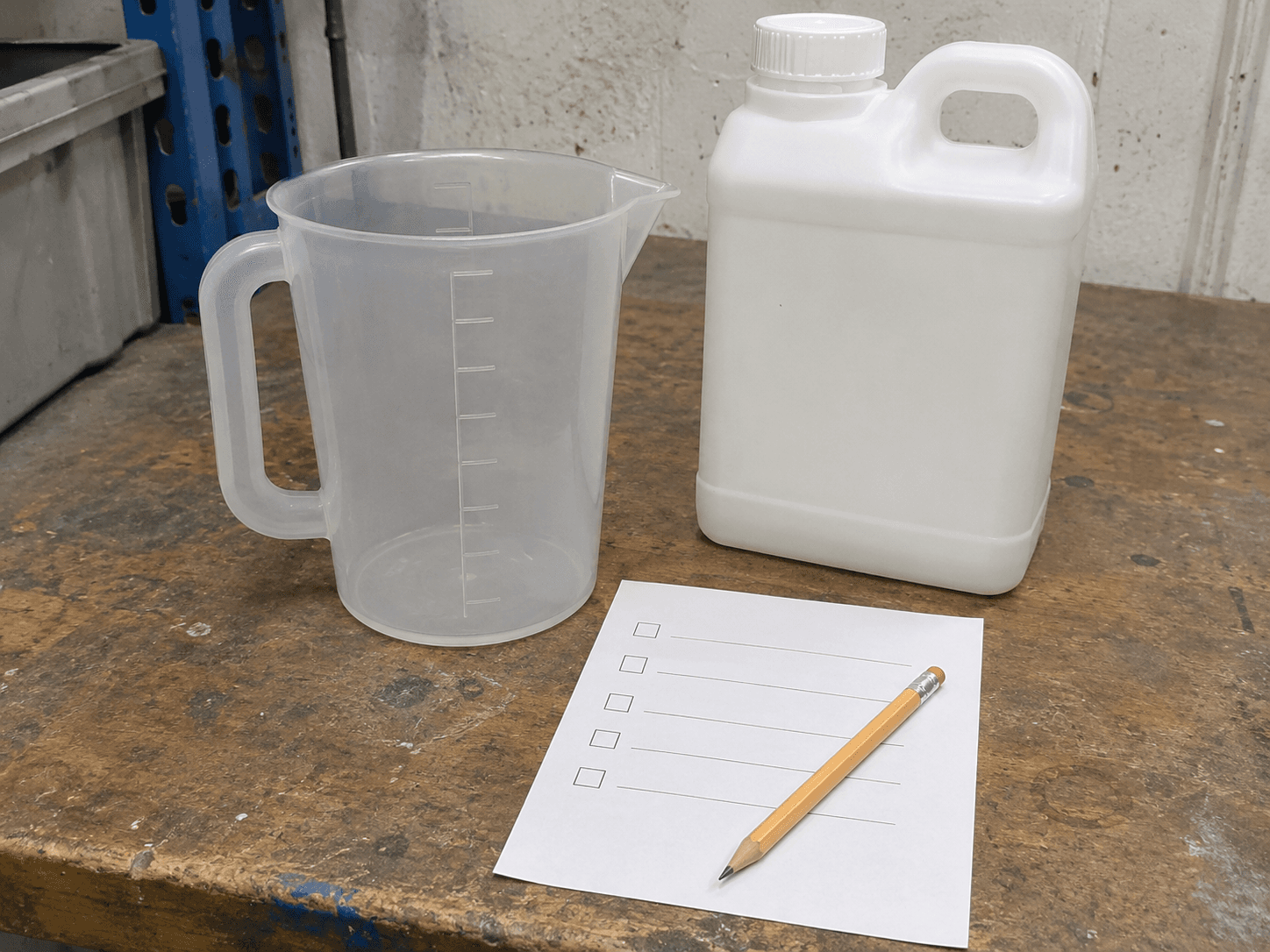
AI-generated illustration: measuring jug and closed, unbranded container on a workshop bench. Concept only; not a Richwood product, operating instruction or test result.
Why “stronger” is not the same as “better”
In wet mass finishing, the process fluid helps carry away material removed from parts and media and helps keep the media surface active. The compound is selected for the material and the job, which may include cleaning, burnishing or corrosion protection.
That does not mean a higher concentration improves each job. Richwood’s catalog description for No. 45 Burnishing Compound specifically states that it will not work in high concentration and is used in high dilution. That is a product-specific limitation, not a dilution recipe for other compounds. Confirm current application instructions before use.
If you have not established which product fits the job, begin with how to choose a mass-finishing compound. Once the product is selected, the next question is whether you can deliver it consistently.
Separate dose, concentration and flow
These three entries belong on different lines of the process record:
- Dose: the amount of compound added, with units and the period or batch it applies to.
- Concentration: the proportion of compound in the mixture, using the supplier’s stated basis.
- Flow: the amount of water or mixed solution delivered per unit of time.
“An ounce” is incomplete if nobody knows whether it means a weight ounce or a fluid ounce, or what quantity of water it goes with. A percentage is incomplete if the mixing basis is missing. Copy the product’s units and instructions exactly; do not convert a powder weight into a liquid volume by guesswork.
For a flow-through setup, the same compound feed with a changed water feed does not produce the same mixture. For a closed batch, record the actual charge rather than borrowing a flow-through instruction. For recirculated fluid, ask how the supplier wants the working solution checked; a record of fresh additions alone does not establish the condition of reused liquid.
What to check before turning up the dose
- Identify the exact product. Record the name, code and current application instructions. A similar name or color is not a replacement specification.
- Confirm the mixing basis. Is the instruction per quantity of water, per batch, or another defined basis? If it is unclear, resolve that before calculating an addition.
- Verify delivery. Record measured compound and water amounts using the equipment maker’s approved checking procedure. A pump setting is a setting, not a measurement of what reached the machine.
- Compare with the last accepted batch. Note changes in incoming oil, part load, media, water supply, cycle and rinse or drying steps. Do not make the compound responsible for every change in the finished part.
- Run a controlled comparison. With the supplier’s guidance, change one relevant variable and inspect representative parts against the same acceptance requirements.
Keep chemical handling and equipment checks within the current safety data sheet and machine instructions. This checklist does not supply a concentration limit or a pump-calibration procedure.
A useful dosing record is short and specific
Record the part and material; machine and process type; compound code; instruction revision; target dose or concentration and its basis; measured compound and water delivery; check method; cycle; and the result against your acceptance criteria.
For example, “pump setting unchanged” tells the next shift very little. “Water delivery checked, compound delivery checked, both compared with the approved setup” identifies what was verified. Keep the actual measurements with that entry.
Define success on the part, not in the bucket: required burr removal, protected dimensions and edges, acceptable appearance, and readiness for the next operation. Do not accept a dose change simply because the liquid looks different.
Can you use foam as a concentration test?
Not by itself. Foam is an observation, not a product-specific concentration measurement. Record when it appeared and what else changed, then use the supplier’s recommended check. Do not increase compound to chase a particular amount of foam, or add another chemical merely to hide it.
What should you send Richwood?
Contact Richwood with the exact compound code, part material, machine, media, current mixing instruction, measured additions or flow, and a description of what changed on the parts. Include the required finished condition and, when available, a representative finished reference.
That gives Kevin a concrete process to discuss instead of a guess about whether the machine needs “a little more.”