
Wet mass-finished parts need a drying method that fits their geometry, handling limits, and next operation—not just a hotter or longer cycle. Start by checking where liquid can remain, whether the parts can tolerate contact with one another, and whether drying granules can enter a feature and stay there. Then evaluate the rinse-and-dry sequence on representative parts.
A part that looks good leaving the finishing machine is not necessarily ready to pack, inspect, coat, or assemble. The handoff matters.
Start with the part and the next operation
Before comparing dryers, put these details on one sheet:
- Material and surface requirement. What is the alloy? What appearance, cleanliness, and corrosion-protection requirements apply after drying?
- Geometry. Which bores, recesses, or cup-shaped features can retain liquid or carry out drying media?
- Handling limits. Are dents, contact marks, or part-on-part rubbing unacceptable?
- Next operation. Is the part going to inspection, assembly, coating, storage, or packaging? Ask that process owner what residue and moisture are acceptable.
- Production pattern. How large is the batch, how frequently does it arrive, and must unlike parts remain separated?
These questions narrow the choice before anyone recommends a machine or drying medium.
Which drying method belongs on the shortlist?
Rösler's dryer guide describes several approaches for parts leaving wet finishing. Use these distinctions to frame a trial—not as proof that a particular dryer fits your job.
| Part or workflow concern | Approach to evaluate | What the trial must establish |
|---|---|---|
| Parts that can tolerate movement with drying media | A media-based rotary drying process | Media can be separated completely and the finish survives handling. |
| Sensitive surfaces or deep, small bores | A hot-air belt dryer | The part dries in the features that matter without unacceptable handling marks. |
| Flat or scoop-shaped parts that carry out media or obstruct a separation screen | A drum-dryer arrangement designed for that behavior | Parts discharge consistently and media carryout is acceptable. |
| Small parts processed as a suitable, unmixed load | A drying centrifuge designed for the parts | Basket loading, part contact, and separation meet the job's requirements. |
Rösler specifically identifies belt dryers for sensitive parts and deep, small bores where drying media could lodge. It also limits the stated suitability of its HTZ drying centrifuges to small parts, excluding workpiece mixtures. Those are manufacturer-specific descriptions, not a universal rule for every machine.
A drying centrifuge is drying equipment. Do not confuse it with a centrifugal barrel finishing machine, which uses media and compound to finish the surface. Similar words do not make the machines interchangeable.
Drying media creates another separation decision
You may have already checked whether the finishing media fits a hole. Do the same check for any proposed drying granules.
The question is not simply, “Will this material absorb moisture?” It is also, “Will every part come out without retained material?” Include the smallest relevant features and awkward orientations in the trial, and define how you will inspect them.
For the related finishing-media problem, see Tumbling Media Stuck in Holes?. That article covers media fit and wear; this decision is about the downstream drying step.
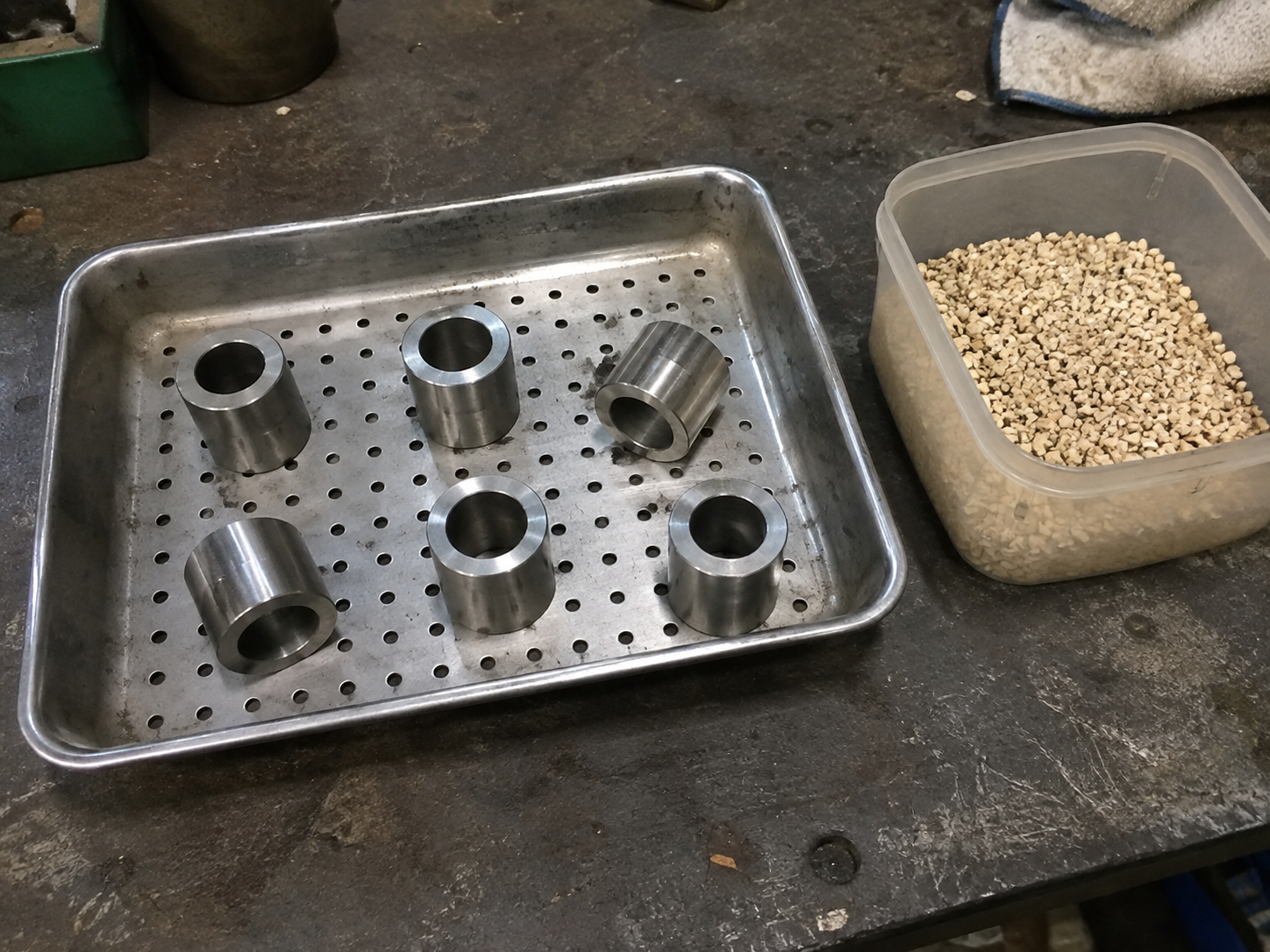
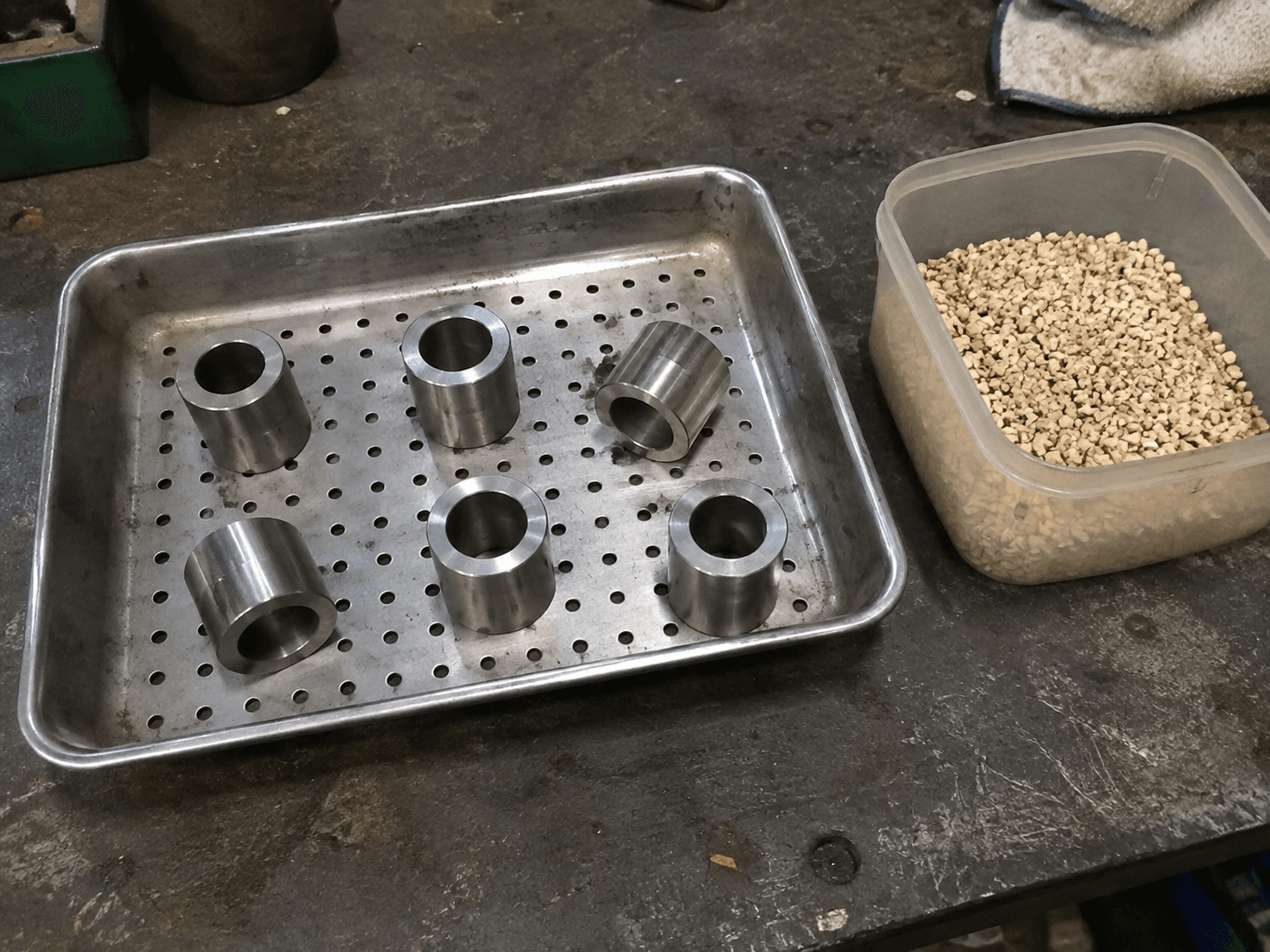
AI-generated illustration: generic metal sleeves beside drying granules on a workshop bench. Not a Richwood product photograph, customer part, or measured drying trial.
Check the rinse-to-dry handoff, not drying alone
Document the sequence from the last wet step through the next operation. Record the rinse method, how parts drain, the delay before drying, the dryer settings, the load, and the inspection result. Keep those conditions consistent when comparing alternatives.
If a mark or residue appears, record when it first becomes visible. Inspect a representative part after the rinse, after drying, and at the next operation. Do not assume a longer drying cycle will correct a cleaning or residue problem.
Rösler also offers integrated washing and drying systems. Their existence is a useful reminder to evaluate handling between operations. It is not a recommendation to replace your line, or a claim that Richwood stocks those systems.
What counts as a successful trial?
Agree on acceptance checks before the run:
- Dryness: check the surfaces and internal features identified on the drawing or inspection plan, not just the easy-to-see face.
- Surface condition: compare with the agreed reference for marks, residue, and appearance.
- Separation: verify that no unacceptable drying medium remains in the part or follows it downstream.
- Next-step compatibility: have the responsible team confirm that the dried part meets its incoming requirements.
- Repeatability: repeat with a representative production load before treating one good-looking part as a qualified process.
Record elapsed time as well, including transfer and inspection. The batch-time guide covers that wider timing question; here, the first gate is whether the dried part is acceptable.
Common questions
Can I use one temperature and time for every part?
Do not assume so. Establish settings with the equipment and process supplier for the material, geometry, load, and next-step requirements. This guide deliberately provides no universal temperature or cycle recipe.
Are drying granules always the best choice?
No. Their ability to separate from the part matters. Rösler's guide specifically points to hot-air belt drying for some sensitive parts and parts with bores where media could stick.
Does a dry-looking part prove corrosion protection or cleanliness?
No. Appearance alone is not a substitute for the acceptance checks required by your process. Specify those requirements separately and verify them; this guide makes no corrosion-free or cleanliness guarantee.
Bring the whole handoff into the process discussion
When you ask Richwood about a sample test, include the part material, a representative unfinished part, the desired finished reference, the current rinse-and-dry sequence, and the next operation. Confirm the trial scope before shipping, including which downstream checks can be evaluated.
The goal is not just a part that looks finished at the machine. It is a part that is ready for what happens next.