
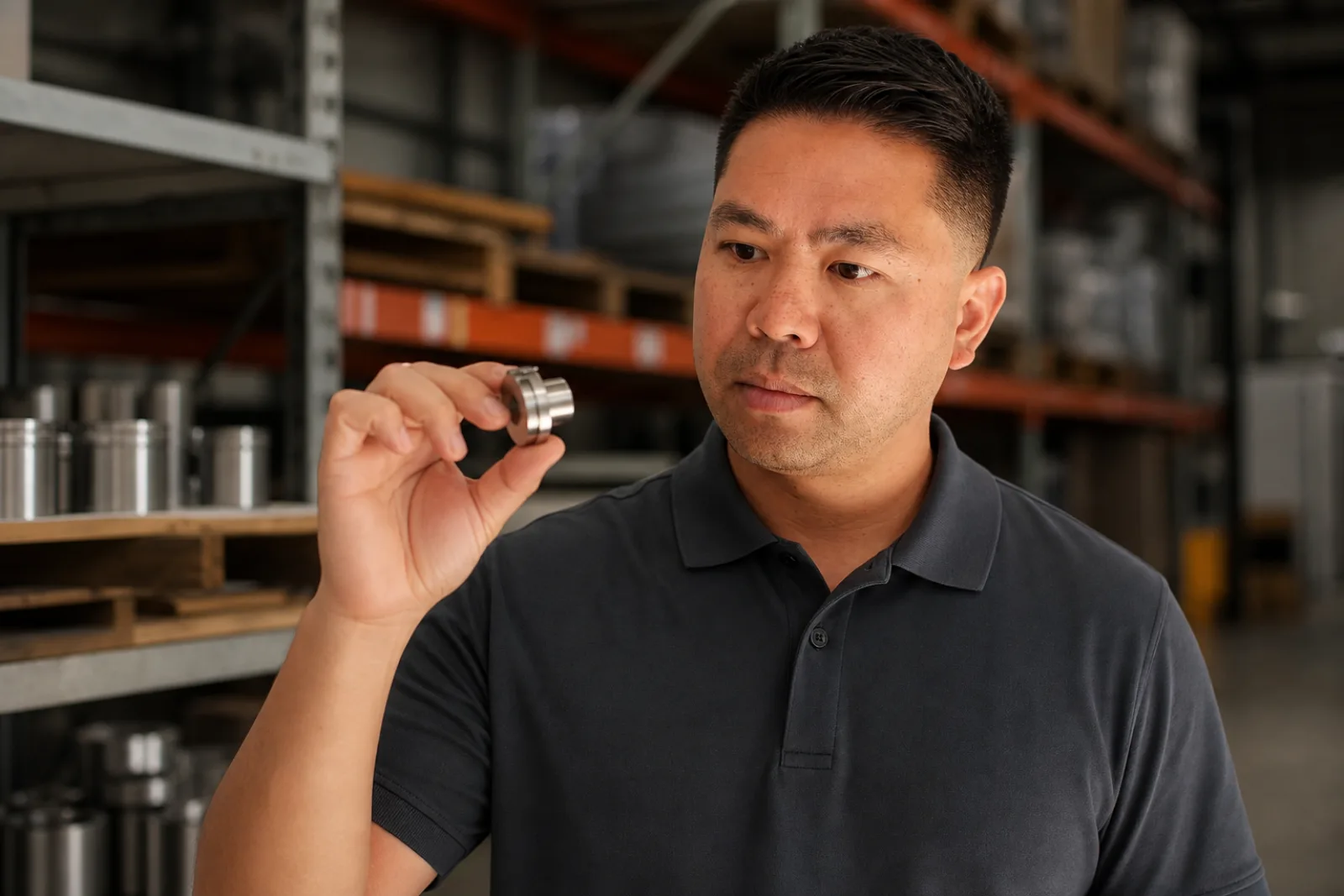
Hand deburring a batch takes a shift and produces an edge that depends on who held the file. Centrifugal barrel finishing does the same batch in about 30 minutes and produces the same edge on every part. One operator on the bench costs roughly $60,000 a year in labor alone. A production machine costs $69,500 and usually pays back inside a year on one line.
That is the comparison in four sentences. The rest is the detail, including the cases where the bench still wins.
What a bench shift actually costs
Take one operator at a fully loaded rate of $30 an hour. That is $240 a shift and about $60,000 a year for one person deburring parts by hand. Your rate and your hours will differ, so put your own numbers in, but the shape of the math does not change.
Now add what the labor line hides:
- Rejects and rework. A missed burr found at inspection or by the customer costs the part, the paperwork, and the trust.
- Queue time. Parts waiting behind the bench are parts not shipped. If deburring is the slowest step, it sets the lead time for the whole order.
- Hiring and training. Skilled deburring hands are hard to find and slow to train. Each turnover costs months.
- Injury exposure. Repetitive hand and wrist work carries a real cost, in people and in premiums.
What the machine does differently
A centrifugal barrel machine presses parts and media into a packed, sliding bed at up to roughly 25 G. Every part is worked in every direction at once. Burrs come off, edges get a small uniform radius, and the surface comes out isotropic, with no directional tool marks. A batch that takes a vibratory bowl 4 to 8 hours often finishes in about 30 minutes. The how it works page has the mechanics.
The operator's job changes from filing to loading, unloading, and inspecting. One person can run four barrels and still have time to check the parts.
Side by side
| Hand deburring | Centrifugal barrel finishing | |
|---|---|---|
| Time per batch | A shift or more | About 30 minutes for most deburring |
| Consistency | Varies by operator, tool, and hour | Same edge on every part, every batch |
| Labor | One operator per bench, all shift | One operator loading and inspecting |
| Surface | Directional marks from the tool | Isotropic, no tool marks |
| Reaches bores and slots | Only what the tool can touch | Everywhere the media can reach |
| Up-front cost | Files and a bench | $9,890 to $97,500 depending on size |
| Best for | One-offs, very large parts, sharp features | Batch work, repeatable edges, finish specs |
The payback math, with example numbers
Say a shop runs one operator on a bench every day. Labor is about $60,000 a year. An RW-120 at $69,500 replaces that shift with a few 30 minute cycles. Media and compound run a few thousand dollars a year at typical volumes. Payback lands inside the first year, before counting the rejects that stop happening and the orders that ship sooner.
For a shop running two benches, the RW-220 at $97,500 does the same for both. Current pricing is on the pricing page. These are example figures. Run yours.
Where the bench still wins
Be honest about this part, because a machine bought for the wrong job sits idle.
- One-off and prototype parts. Setting up a recipe for one part is not worth it.
- Parts too large for a barrel. A 55 liter barrel has limits. Long shafts and large weldments stay on the bench or go to a vibratory tub.
- Features that must stay sharp. A barrel breaks every edge. If one edge must not be touched, mask it or hand finish it.
- Repair and rework. Fixing one part is bench work.
Most shops keep one bench for those and move batch work to the machine.
Before you buy anything
Send us a batch of your real parts, the easy ones and the ugly ones. We run them in the actual machine, write down the media, compound, and cycle time, and send them back so you can hold a hand-deburred part next to a barrel-finished part. Then you decide. Start a sample test. If the answer is yes, the machine is in stock in Los Angeles and ships in about one week. See the in-stock page.
Common questions
Is centrifugal barrel finishing better than hand deburring?
For batch-produced parts, yes. The whole batch finishes in about 30 minutes with the same edge on every part. Hand work still wins for one-offs, very large parts, and features that must not be touched.
How much does hand deburring cost?
One operator at $30 an hour fully loaded is about $240 a shift, or roughly $60,000 a year, before rejects, rework, and queue time.
Why is hand deburring inconsistent?
The edge depends on the person, the tool, and the hour. A centrifugal barrel gives every part the same media, force, and time.
When is hand deburring still the right choice?
One-off or prototype parts, parts too large for a barrel, features that must stay sharp, and repairs.