
A mass-finishing machine's listed volume does not tell you how many parts it can finish per batch. You need the permitted working load, room for the selected media, the part's shape and weight, and a trial that confirms the finished parts pass inspection. On a multi-barrel machine, check each barrel—not just the combined capacity.
Start with the part: How big is it? What finish does it need? How many accepted pieces do you need per shift?
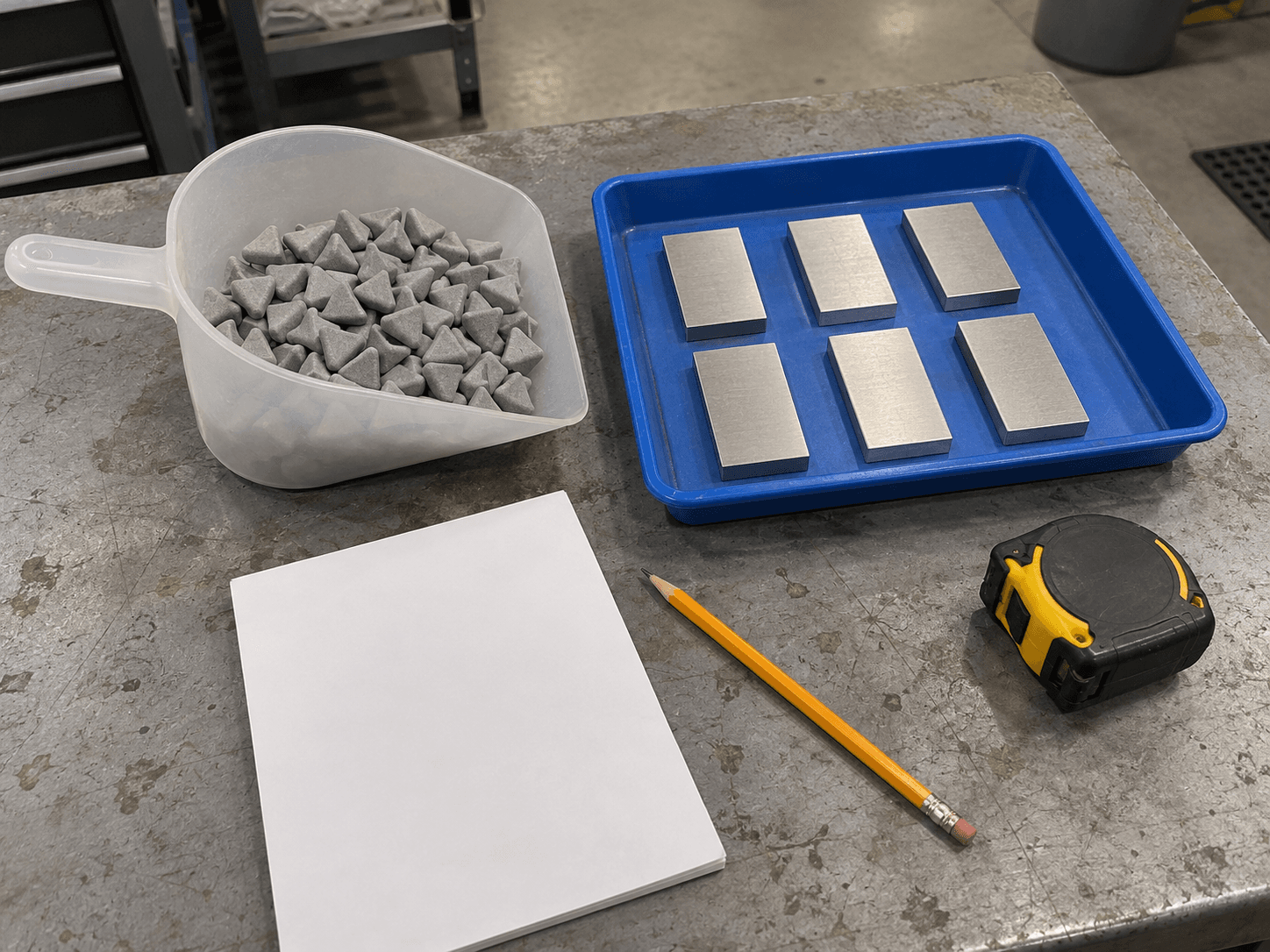
AI-generated illustration: metal coupons in a blue tray beside a scoop of finishing media on a workshop bench. Not a Richwood product photograph, customer part, loading recipe or measured trial.
Ask what the capacity number includes
Equipment listings can describe total chamber volume, working volume or a permitted load. Ask the supplier which definition applies. A number in liters or cubic feet describes volume; a number in pounds or kilograms describes weight. You need both limits for the proposed setup.
The working load includes more than parts. Finishing media—the shaped abrasive or polishing pieces that contact the work—also occupies the chamber. Its job can include keeping parts separated as well as producing the finish. Removing media just to fit more parts changes the process.
Do not apply one fill percentage or media-to-parts ratio to every machine. A vibratory bowl and a centrifugal barrel have different operating requirements. Confirm the load with the equipment supplier and qualify it on the actual parts.
Check each chamber, not just the machine total
Richwood's RW-120 specification lists four fixed barrels of 30 liters each, for 120 liters total. That is four separate spaces, not one 120-liter chamber. It is not a promise of 120 liters of parts per cycle.
A long part still has to fit within an individual barrel, with the clearance and media arrangement the process needs. Dividers also change the space available to each part. Check the proposed configuration and follow the machine's loading and balancing instructions.
The same question applies to a vibratory machine: a part may fit inside the bowl yet not move properly through its working channel. Physical fit is the first check, not proof of a workable batch.
Build a part-specific loading check
| What to establish | What to bring or ask | Why it matters |
|---|---|---|
| Part size and shape | Overall dimensions, weight, holes, pockets and delicate features | Chamber volume alone does not establish clearance or access |
| Proposed batch | Count and measured load weight, with the selected media | Weight and volume are separate constraints |
| Process arrangement | Media type, size, quantity, working fill and any dividers | A change here can alter contact and finishing action |
| Acceptance | Burr condition, critical dimensions, edge limits and required finish | A larger batch is useful only if the parts pass |
| Output target | Accepted pieces needed per shift and time available | A batch that fits may still miss the production requirement |
For irregular parts, use a representative sample load to check the estimate. A calculation from solid material volume alone does not show how the parts occupy space or interact with media. Do not treat how tightly parts pack in a shipping box as a finishing-load specification.
Prove the batch before choosing the machine
Have the proposed part-and-media load evaluated within the manufacturer's operating limits. Check the required surfaces and features, including any contact damage or trapped media. Confirm that unloading and separation work for that batch too.
Keep the accepted part count with the tested setup. If you change part geometry, media, dividers or batch quantity, recheck the result rather than assuming the old capacity still applies.
Then compare accepted output with the production requirement. Include the complete workflow, not just time under power. Our batch-time guide explains what to measure without turning a catalog capacity into a throughput promise.
Common sizing questions
Can I calculate parts per batch from the advertised liters?
Not reliably from liters alone. Establish what the rating means, then check part geometry, the media load, weight limits and the qualified operating setup.
Can I add more parts if there is room left?
Unused-looking space is not automatically spare parts capacity. Adding parts changes the load and media-to-parts relationship. Confirm the revised setup and its results before using it for production.
What should I send Richwood for a sizing discussion?
Send part dimensions and weight, representative unfinished parts or clear photographs, the required finish and accepted output target. Include the existing machine and media if you already run the job. The sample-test checklist helps organize the details.
Talk with Richwood about your part and production target before selecting a machine from its capacity label alone.