
New tumbling media may need conditioning before it runs production parts, but the answer depends on the exact product. Follow the media supplier's instructions for that grade and your machine. Do not borrow a break-in time from another material—or use valuable parts to find out whether a new charge is ready.
The useful question is not simply, “How many hours should I run it?” It is, “What preparation does this media require, and how will we confirm that it produces an acceptable part?”
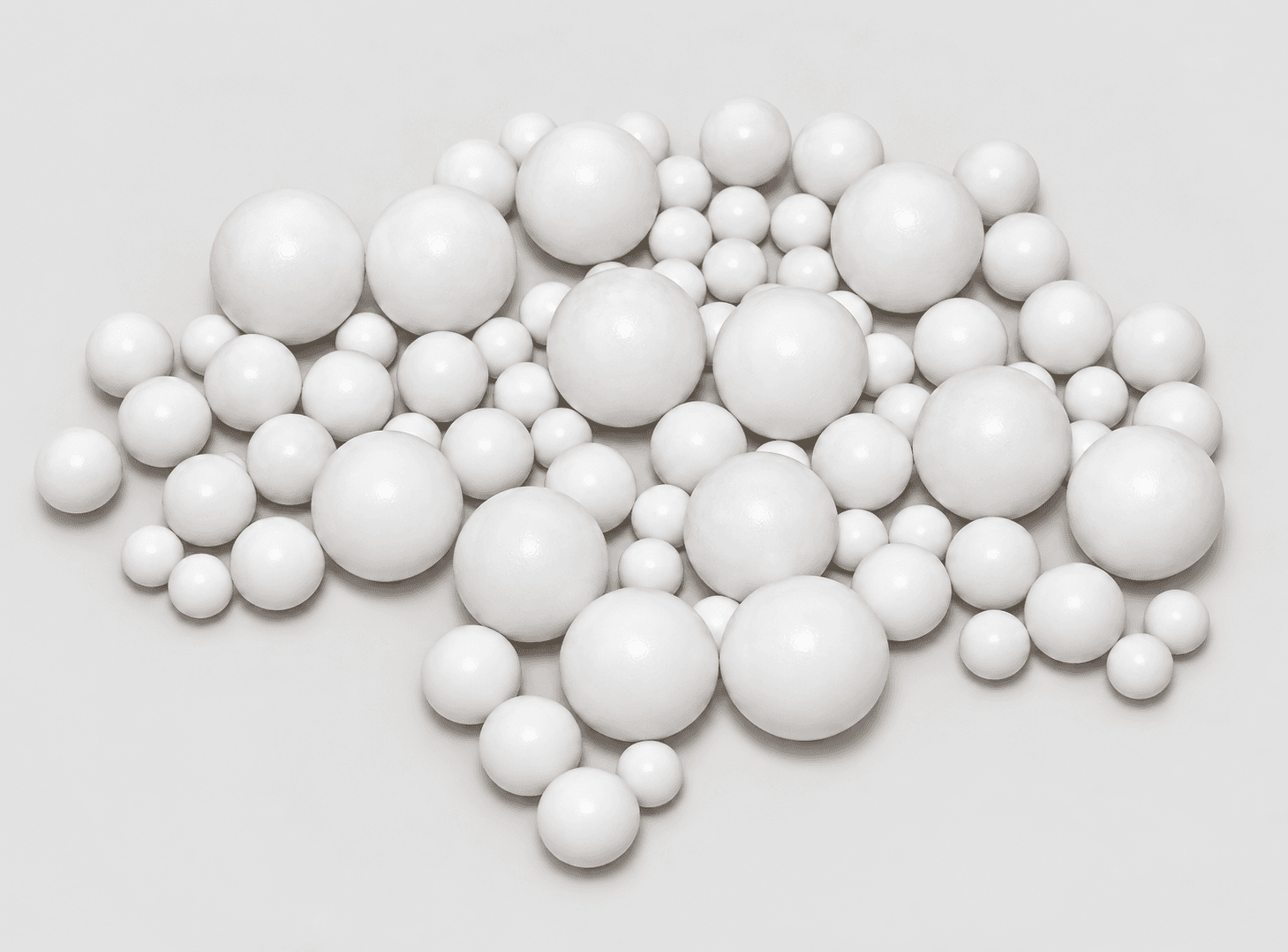
Richwood catalog image of porcelain polishing spheres. AI-enhanced background; images are not to scale. Not a measured finishing result or a conditioning instruction.
Start with the product, not its color
“Ceramic,” “plastic,” and “porcelain” identify broad families, not complete operating instructions. Keep the supplier, product code, composition or cutting grade, shape, and size with the process record. A bag that looks like the last one is not enough to establish that its preparation requirements are the same.
Some products explicitly call for break-in. For example, a manufacturer's current porcelain-ball instructions specify a conditioning period for that particular media. That is evidence that break-in can matter—not a recipe for every porcelain ball or every tumbling machine.
For a replacement order, compare the label with your approved record before opening the bag. Richwood's media and compounds catalog can help identify the family; confirm the exact item and preparation requirements before putting it into service.
Ask these five questions before the first run
- Does this exact media arrive ready to use? Ask whether it needs cleaning, conditioning, or another supplier-defined preparation step. Do not assume “new” means either ready or unready.
- What setup does the instruction assume? Confirm the machine type, charge, liquid and compound requirements, operating settings, and endpoint. An instruction written for one setup is not automatically transferable to another.
- Should parts be present during preparation? Obtain the supplier's answer rather than inventing a parts-to-media ratio or adding scrap at random.
- What happens after conditioning? Clarify how to separate, rinse, inspect, and identify the prepared media before the trial.
- What proves it is ready for this job? Agree on the part checks, not just elapsed time or a visually clean bowl.
“Conditioning” here means the supplier-prescribed preparation of new media. It is not a general instruction to restore worn media, remove glazing from an old charge, or change the cutting behavior of an unsuitable grade.
Separate preparation from part acceptance
Finishing the preparation cycle does not prove that a production part meets its requirements. Treat those as two different decisions.
First, document that the specified media preparation was completed. Then run a controlled trial using representative parts and the intended production process. Keep an unfinished reference and a clearly identified target finish. Choose the trial quantity and settings with the process supplier; this article does not prescribe them.
Use a short acceptance sheet:
| Check | Record before approving production |
|---|---|
| Burr or edge requirement | Which features must change, and which must remain protected? |
| Surface requirement | Is appearance sufficient, or is a specified roughness measurement required? |
| Dimensions and fit | Which drawing dimensions or functional checks must still pass? |
| Media removal | Can media be separated and relevant holes or recesses checked? |
| Downstream condition | Does the cleaned, dried part meet the next operation's requirements? |
This is a proposed trial checklist, not a claim that Richwood has validated a particular combination. Use the drawing and the customer's acceptance criteria to decide what belongs on it.
If the first parts look different, stop changing everything at once
A changed result after a media replacement is a reason to investigate, not proof that break-in was skipped. Check the supplied item against the order, review its preparation instructions, and compare the actual setup with the previous accepted process.
Keep a record of what changed: full replacement or top-up, media identification, preparation performed, machine settings, compound, water practice, part load, and inspection results. Preserve an example of the unexpected result. Changing several variables together makes the next comparison harder to interpret.
Do not continue extending the cycle until the parts “look about right” if critical edges, fits, or dimensions are at risk. Resolve the process question before committing the full production lot.
What to send when asking for help
Send the media label or order code, machine model, part material, relevant geometry, current process details, and a photo of the result you need. Say whether you are replacing the whole charge or adding media to an existing process. Include the supplier's conditioning instruction if you have it.
Ask Richwood about your media and process. Start with the exact product and the part requirement; then establish the preparation and trial needed for that combination.