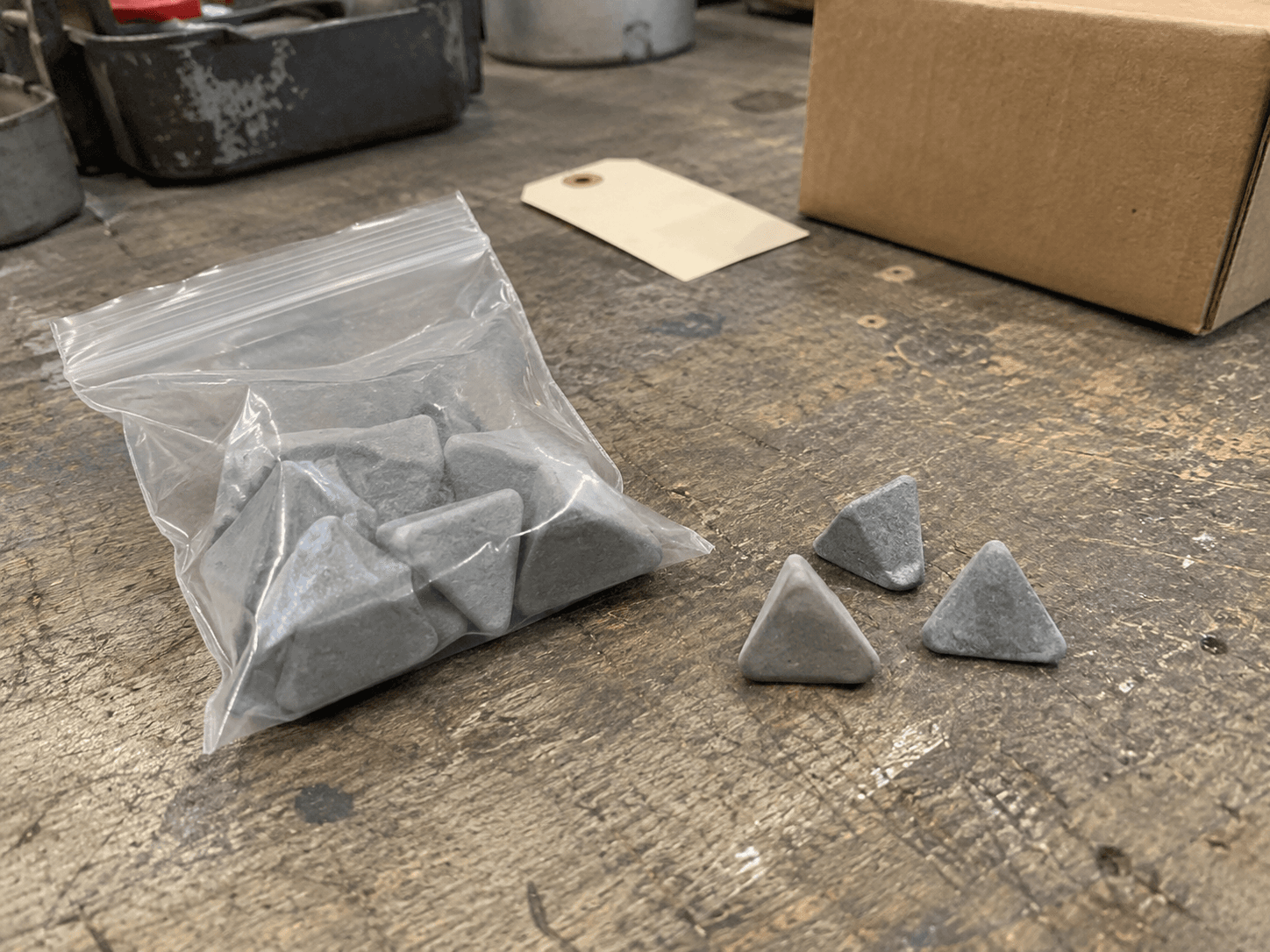
A photo can help identify tumbling media's shape. It cannot, by itself, confirm the formulation, original size or a replacement that will produce the same finish. For a reliable reorder, start with the bag label or previous product code, then add measurements, clear photos and the job the media is doing.
Before ordering “the same gray triangles,” answer two questions: What exactly was supplied, and are you trying to repeat the same result or change it?
AI-generated illustration: generic ceramic media beside a sample bag and blank tag. Not a Richwood product photograph, customer sample, size reference or measured test.
Start with the label, not the color
Look for the original bag label, product code or an earlier order description. Keep the shape, size and formulation together. Formulation means the material recipe that determines the media's cutting or polishing characteristics; it is not another word for shape.
Supplier catalogs list multiple formulations for the same shape and nominal size. Two pieces that look alike therefore should not be treated as interchangeable. A photograph is a useful clue, not a formulation test.
If the label is missing, say so. Send what you know and mark the rest unknown. Guessing a code can make an uncertain match look confirmed.
Give each photo a specific job
Take an end view and a side view of a few clean pieces. Put a ruler beside the media for scale, keeping it close to the same plane as the piece. Include a separate readable photograph of the label if available. Avoid glare and keep the shape in focus.
Write the actual measurements in the inquiry too. A photo beside a ruler helps with identification; it does not replace measuring the piece.
Use the media measuring guide to match the shape drawing before recording dimensions. A, B and C are the distances marked on that drawing, not a universal length-width-height order. Record the units and keep the cut angle separate from the dimensions. If the drawing does not show a third dimension, do not invent one.
Tell us whether the sample is new or worn
A used piece can be smaller and rounder than the media originally ordered. Measure several pieces and report the range if they differ. If you have an unused piece from the same identified batch, include its measurements separately.
Do not turn one worn measurement into a new nominal size without checking the original specification. The question is not simply “What size is this piece today?” It is also “What was the intended replacement?”
Send a reorder brief, not just a picture
| Information | What to include | Why it matters |
|---|---|---|
| Product identity | Bag code, supplier description or previous order reference | Separates a documented reorder from an identification request |
| Shape and dimensions | Shape name, labeled measurements, units and cut angle if known | Reduces ambiguity between similar-looking pieces |
| Condition | New or used; measurement range from several pieces | Makes wear visible in the comparison |
| Formulation | Exact code if known; otherwise “unknown” | Shape and size alone do not establish cutting behavior |
| Application | Part material, machine/process and the finish or burr-removal goal | Gives context for reviewing a possible substitute |
| Sensitive features | Holes, slots, critical edges and separation concerns | Flags where a different geometry needs closer evaluation |
| Intended change | Same established process, or a different result | Keeps a reorder from becoming an undocumented process change |
Share only information you are authorized to share. A useful process description does not require a customer name or confidential drawing.
A substitute is a separate decision
If the original code is unavailable, separate “possible match” from “approved replacement.” A similar shape and size can still be supplied in a different formulation. Ask what is known about the candidate and what remains uncertain.
Before introducing a changed medium into an established production process, agree on how to check representative parts against the required finish, edge condition and dimensions. Check whether the media can be removed from the part and separated from the batch. Use your own applicable process-change and quality requirements; a catalog resemblance is not an acceptance criterion.
There is no single trial recipe that proves every substitution. The right check depends on the part and the result you need to preserve.
Quick answers
Can you identify the formulation from its color?
Do not rely on color alone. Use the exact product code or supplier documentation. Treat an unknown formulation as unknown until it is confirmed.
Should I order the size of the worn pieces in my machine?
Not automatically. Report those measurements as used-media measurements and compare them with the original label or specification before choosing the replacement size.
Does the same shape and size mean the same media?
No. Formulation is a separate specification. A same-size candidate still needs its identity and suitability checked.
Make the next inquiry easy to answer
Have the bag code, side and end photos, labeled measurements and a short description of the part and desired result ready. Then contact Richwood to review the media identification and replacement options. Say clearly whether this is a repeat order or a proposed process change.