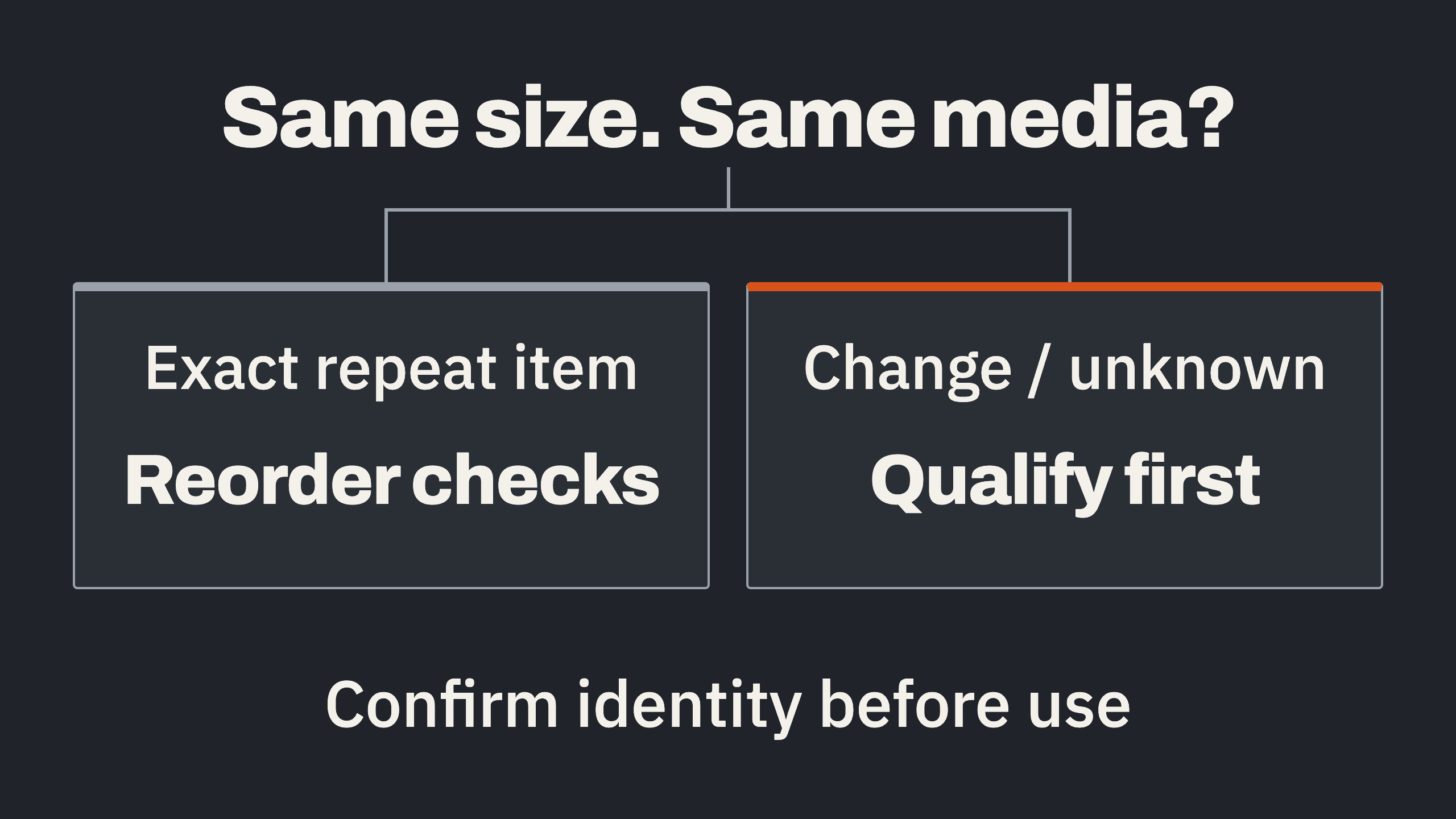
Matching shape and size is not enough to call replacement tumbling media equivalent. Confirm the exact formulation or cutting grade as well. If the grade changes or nobody can identify it, treat the bag as a proposed substitute, not a routine top-up. Agree on a trial before it goes into the production charge.
Start with a simple question: Are we replacing the item we already use, or qualifying a different one?
That distinction belongs on the purchase request. Otherwise, purchasing can order the right-looking shape while production receives an untested change.
A size describes geometry, not the whole product
A supplier can list one shape and nominal size in several formulations. Its size table answers “What geometry is available?” The formulation column answers a different question: “Which version of that media are we discussing?” Neither column replaces the other.
That is why “ceramic triangles, same size” is an incomplete substitution request. Record the supplier, full product or formulation code, shape, nominal dimensions and units together. Preserve the supplier's exact wording; do not assume similar grade names from different suppliers mean the same thing.
The media measuring guide helps identify the physical dimensions. A, B and C follow the selected shape drawing; they are not a universal length-width-height order. Measure several pieces if the working media is worn, and label those readings as used-media measurements. They do not establish the original ordered size or the abrasive formulation.
If the old bag label is missing, say “grade unknown.” A confident guess does not make the next order more repeatable.
Separate three different buying situations
| What you have | What the buyer should request | What production still needs |
|---|---|---|
| A documented repeat item with the same supplier, code, formulation, shape and size | Reorder against that exact specification; confirm any supplier changes | Incoming identification and the established preparation, replenishment and part-acceptance checks |
| A known change in grade, supplier, shape or size | A clearly identified substitution proposal, with each difference listed | An agreed comparison on representative parts before production release |
| A worn sample or photo without a traceable grade | Identification help, not an “equivalent” certification | Resolve what can be identified; qualify any proposed replacement against the part requirements |
A full changeout and a routine addition of fresh media are also different events. Even the correct new product may have preparation requirements. Follow the supplier's instructions for that exact media and machine; do not borrow a conditioning time from another product. See new-media preparation and break-in for the questions to settle first.
Use a change sheet before opening the replacement bag
The worksheet below is a proposed control aid, not a supplier specification or a completed Richwood trial. Keep it with the purchase request and process record. An empty cell means the question is still open; it is not permission to assume a match.
Replacement-media comparison worksheet
Part / drawing revision: __________
Machine / process: __________
Decision owner: __________
Trial reference: __________
| Check | Current approved item/process | Proposed replacement | Same, changed or unknown? |
|---|---|---|---|
| Supplier and full product code | __________ | __________ | __________ |
| Formulation / cutting grade | __________ | __________ | __________ |
| Shape and nominal size, with units | __________ | __________ | __________ |
| Actual condition: new, conditioned or working mix | __________ | __________ | __________ |
| Required preparation and instruction reference | __________ | __________ | __________ |
| Charge, compound, water and operating settings | __________ | __________ | __________ |
| Separation, rinsing and drying route | __________ | __________ | __________ |
Features that must pass: burr location __________; protected edge __________; critical dimension __________; surface requirement __________; cleanliness / next operation __________.
Acceptance method and limits: __________. Use the drawing and agreed process requirements, not values invented for this worksheet.
Disposition:
☐ identity unresolved
☐ trial required
☐ accepted for the recorded scope
☐ rejected.
Evidence / authorized sign-off: __________. A checked box is not a substitute for the inspection record.
Worksheet caption: Original Richwood editorial worksheet for this article. Blank fields are intentional. It records a proposed comparison; it shows no customer data, measured result or universal finishing recipe.
Compare against the part, not just the last timer setting
Before a substitution trial, agree on the incoming parts and the checks that will decide the result. Use representative unfinished parts, including the difficult burrs and protected features, plus an acceptable finished reference where useful. A reference part helps communicate appearance; it does not replace dimensional limits or the specified surface inspection.
Keep the candidate identified and separate while the evaluation is unresolved. Adding unknown media to the working charge makes it harder to tell which media produced a later result.
For a meaningful comparison, record what stays the same and what changes. Do not quietly change the media, compound, load and cycle together and then attribute the result to the new grade. If the supplier requires a different preparation or operating setup, document that explicitly: you are comparing two process routes, not isolating one variable. Never override the machine or media instructions to make the comparison look tidy.
Check the complete output after separation, rinsing and drying as applicable:
- Was the specified burr removed at the identified location?
- Do the protected edges and critical dimensions still pass?
- Does the required surface meet its agreed inspection method?
- Is media trapped in holes or slots, or carried into the next operation?
- Are cleanliness and downstream requirements satisfied?
If a critical feature fails, the trial has not passed because the part looks brighter or the cycle finishes sooner. Return to the supplier with the failed feature and the recorded setup. Do not automatically extend the cycle when a dimension or edge is already at its limit.
Approve the scope you actually tested
An accepted result for one part family and setup does not qualify the replacement for every job in the shop. Record the media identity, preparation, machine, charge, settings, part family and inspection evidence that supported the decision. Follow your quality system and any customer-specific change-approval requirements before production release.
Then compare operating cost using accepted output, not the bag price alone. Include separation effort, media carryover and rework in that discussion. The cost-per-accepted-part guide covers that separate buying decision.
Bring both specifications, not just the cheaper quote
Contact Richwood with the current media code or label, the proposed replacement specification, your machine, part material and the finish you need. Say which details are unknown and whether this is a repeat order or a proposed change. Have unfinished-part photos and the critical acceptance requirements ready; confirm sample arrangements before shipping anything.
The useful answer is not “these bags look alike.” It is whether the identified replacement can meet your part requirements in an agreed process.