Robot deburring is worth evaluating when a tool needs to work on specific accessible features. Batch mass finishing is worth evaluating when media can reach the required surfaces and the parts can tolerate the process. Neither is the automatic winner. Start with the burr, the features that must stay unchanged, and the finished part you will accept.
A demonstration can show a useful capability. It cannot tell you whether that process will meet your drawing, handle your incoming variation or clear your production queue.
What the new robot demonstration does—and does not—tell you
In its October 13, 2026 Pi API beta announcement, Physical Intelligence describes Almond's Axol robot deburring spacers used in its own assembly. The company says the team obtained the model after four days of iteration with the API.
That is a relevant development for shops considering deburring automation. It is also a vendor-reported example, not a head-to-head production study. The announcement does not establish a comparative cost per accepted part, dimensional capability or sustained deburring throughput against a centrifugal barrel or vibratory machine. Four days of model iteration is not a quoted installation time for your shop.
The useful question is not whether a robot can deburr a spacer. It is what your part needs—and what evidence would justify changing your process.
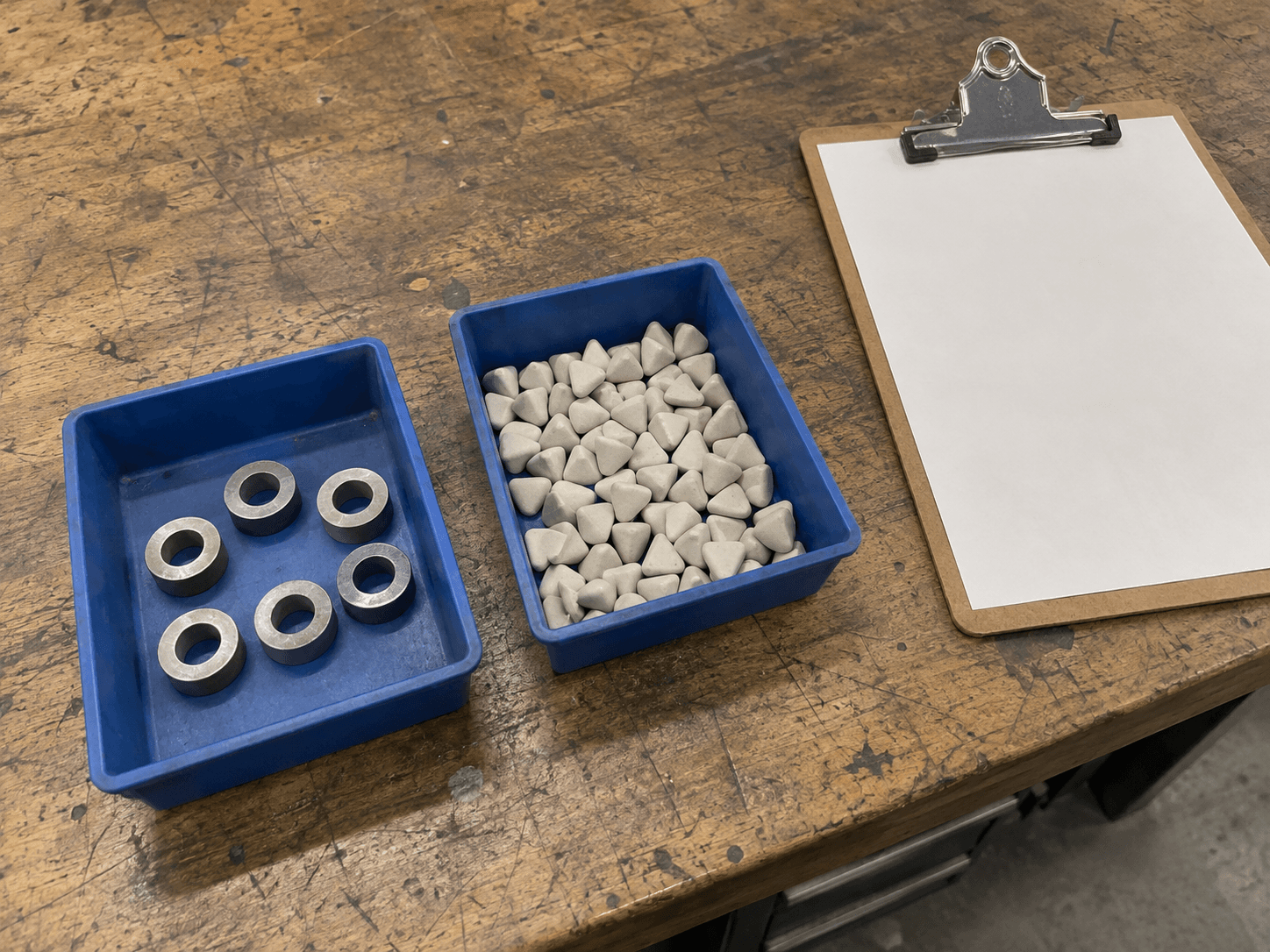
AI-generated conceptual illustration: generic metal spacers and ceramic media on a workshop bench. Not the Axol demonstration, a Richwood product, a customer part or a measured finishing trial.
First separate the finishing job from the automation
Mass finishing uses relative motion between parts and media to remove material or change a surface. Centrifugal barrel and vibratory finishing are two process families; the machine, media, compound and load must fit the job.
A robot is a way to handle a tool or a workpiece. It does not, by itself, specify the cutting action or the acceptance standard. Robot-assisted finishing and media-based finishing can overlap, so this is not always a choice between two mutually exclusive technologies.
For an initial comparison, distinguish a targeted tool operation from a loose-part batch process. Then ask what each proposed system actually includes.
| Decision question | Targeted robot/tool process: ask for | Loose-part batch finishing: ask for |
|---|---|---|
| Where is the burr? | Proof the tool can reach and remove it through the expected variation | Proof media reaches and works on that feature, not just the outside of the part |
| What must not change? | Inspection of adjacent surfaces, dimensions and edges after tooling contact | Inspection of critical edges, bores and surfaces exposed to the batch process |
| How will parts be handled? | A demonstrated loading, locating, gripping and unloading method | A qualified load, part-contact check and reliable media separation method |
| How much product variety is there? | Changeover requirements for tools, fixtures and control settings | Separate qualified recipes or loads where part families need different treatment |
| What leaves the process ready for the next step? | Cleaning and inspection requirements, not just a completed robot motion | Separation, rinse, drying and inspection requirements, not just an ended machine cycle |
These are evaluation questions, not a promise that either process can meet every row. A deep internal burr, a fragile feature or a heavy burr attachment may require another method or an upstream machining change.
Protect the feature before chasing the cycle time
Put the drawing and the part on the bench. Mark the burr that must go, the surfaces allowed to change, and the features that must remain within specification.
If one edge needs work while adjacent features must remain untouched, ask whether a targeted operation offers the required control. If many accessible edges need similar treatment, ask whether a batch process can do that work without unacceptable edge rounding, part contact or media lodging.
Do not assume a shiny outside surface proves that an internal burr is gone. Our guide to deburring internal holes explains that distinction. For critical edges, start with the edge-control checklist.
Compare the complete job on the same acceptance standard
Give each process candidate representative unfinished parts and an agreed finished reference, supported by drawing requirements. Include the variation you expect in production—not only the easiest sample.
Ask for a trial record that answers four questions:
- Did it remove the specified burr? Identify the location and inspection method. Agree how inaccessible features will be checked.
- What else changed? Check relevant dimensions, edge condition, surface finish and cosmetic limits. Use the required units and measurement method; appearance alone is not the acceptance standard.
- What work remained? Record loading, setup, tool or media handling, separation, cleaning, drying, inspection and any touch-up.
- Can the result be repeated? Record the process settings and consumables, then agree what additional runs and incoming variation are needed before production acceptance.
Measure hands-on labor separately from elapsed time. For a meaningful cost comparison, include the agreed labor, consumables, equipment and support costs and divide by accepted output. A short demonstration, a nominal batch capacity and an unattended motion are not interchangeable measures of production capacity.
Our guide to the time outside the finishing cycle can help define that comparison. There is no universal break-even quantity: the part mix, acceptance criteria, handling and changeovers can change the answer.
What should you bring to the first conversation?
Start with the material, part dimensions, burr location, critical features, required finish, typical lot size and current bottleneck. Photos help explain the problem; representative unfinished parts and an accepted finished reference help establish the target.
You do not need to choose a machine before that conversation. Discuss your part and finishing requirements with Richwood to evaluate whether centrifugal barrel or vibratory finishing belongs in your comparison. Confirm the sample scope and next steps before sending parts.