
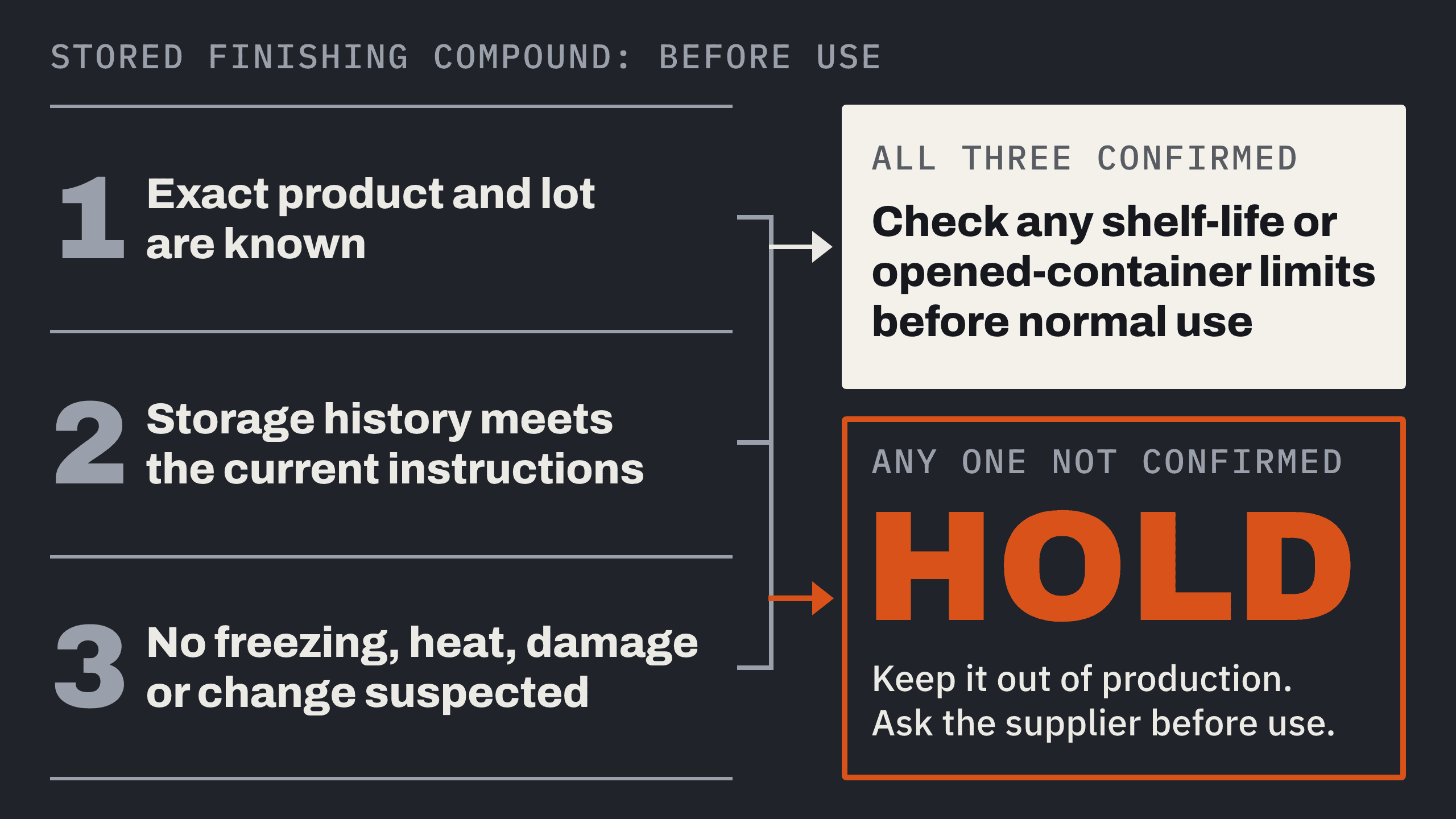
A stored finishing compound may still be usable, but its age or appearance alone cannot establish that. Confirm the exact product, its storage instructions and what happened to the container before returning it to production. If its identity is uncertain, it may have frozen, or its condition has changed, hold it for supplier guidance rather than trying to fix it in the machine.
A compound is the process chemical used alongside the media and water in many wet mass-finishing processes. Different products do different jobs. A storage rule for one cleaner, burnishing compound or polishing emulsion is not automatically a rule for another.
The practical question is not simply, “Is this old?” It is, “Can we establish that this is the right product, in usable condition, for this process?”
Start with the container and the records
Before opening or moving a suspect container, follow your site's chemical-handling procedures. Photograph the existing label if it is safe to do so. Record the product name, full code, lot or batch identifier, and any manufacture or expiry date. Keep suffixes in the code; do not assume two similar names mean the same product.
Then separate what you know from what you are estimating:
- When was it received, and when was it first opened?
- Was it kept in its identified original container?
- Where was it stored, and were those conditions within the product instructions?
- Is freezing, excessive heat, contamination or container damage suspected?
- Is this concentrate as supplied, a premixed solution, or fluid recovered from a process?
Write “unknown” where the record is missing. A delivery date is not necessarily the manufacture date, and the history of a diluted working solution is not the history of unopened concentrate.
Use the right document for the question
A safety data sheet, or SDS, explains hazards and safe handling. In the standard SDS format, Section 1 identifies the product; Section 7 addresses handling and storage; Section 8 covers exposure controls and personal protection; and Section 10 covers stability, reactivity and conditions to avoid.
Read the current SDS for the exact product together with the label and technical instructions. Ask the supplier about shelf life, opened-container limits, and any permitted assessment after a storage excursion. Do not treat a general phrase such as “store in a cool, dry place” as a complete shelf-life specification or permission to use material after freezing.
There is no universal temperature range or expiry period in this guide. Those are product-specific questions.
If freezing or a change in condition is suspected, stop guessing
Do not assume that thawing, warming, stirring or filtering makes a compound suitable again. Conversely, do not declare every product unusable merely because another manufacturer's emulsion cannot tolerate freezing. The supplier needs the actual product identity and history to assess the situation.
Keep uncertain material out of production under your site's hold procedure. Do not blend it into a fresh container to hide a difference. Do not add water or another chemical as a repair unless the product supplier provides an appropriate instruction and your site authorizes it.
If a container is leaking, swollen or otherwise unsafe, use the site's chemical incident procedure and the product SDS. This article is not a spill-response or disposal instruction. Never deliberately smell or touch a chemical to judge whether it is good.
Decide what happens next
| What you know | Appropriate next step |
|---|---|
| Exact product and lot are known; storage history meets the current instructions | Check any applicable shelf-life or opened-container limits before normal use. |
| Label is missing or product identity is uncertain | Hold the material. Seek identification from records and the supplier; do not infer identity from color. |
| Freezing, heat exposure or a change in condition is suspected | Give the supplier the exposure history and product details. Ask for disposition instructions before use. |
| Container is damaged or leaking | Follow the site's safety procedure and current SDS; do not make a production trial the next step. |
| Supplier permits use subject to checks | Document those conditions and obtain the required site authorization before the agreed process check. |
| Supplier cannot establish suitability | Keep the hold in place and arrange an appropriate replacement or disposal route with the responsible personnel. |
These are decision checkpoints, not a laboratory test method. Supplier advice on chemical condition and your own quality requirements answer different questions; both may matter before a production release.
Separate chemical clearance from finishing performance
Even when the material is cleared for use, the finished part still has to meet its requirements. Where your quality procedure calls for a check, use the established process and agreed acceptance criteria. Record the compound lot and the checks performed so the result can be traced.
Depending on the job, those criteria may include burr removal, surface appearance, critical dimensions, cleanliness and the next operation. Do not change the media, compound dose and cycle at the same time merely to make questionable material appear to work. A satisfactory-looking part does not establish the chemical's identity or resolve an unsafe storage history.
If the real question is whether you have the right product for the job, use the guide to choosing a mass-finishing compound. That is a separate decision from whether a particular stored container remains suitable.
Make the next storage decision easier
Keep product identity and lot information with the material. Record receipt and opening dates where your procedure requires them, retain the applicable instructions, and keep held material clearly separate from material released for use. Base storage conditions and container handling on the specific product rather than a rule copied from another finishing chemical.
For an assessment, have the product code, lot, label photo and storage history ready. Then contact Richwood to help identify the product and the next supplier question. Do not ship a suspect chemical sample without first agreeing on safe, authorized handling and transport.