Do not assume plastic media can replace ceramic media while keeping the same production recipe. Plastic-bonded abrasive media are generally less dense and are often candidates for gentler finishing. But the actual grade, shape, size, machine and load determine whether the new process removes the burr and protects the part. Qualify the change against your acceptance requirements before releasing production.
Start with two questions: What is wrong with the current result? What does an acceptable part look like?
A surface mark, an oversized edge radius and an unfinished burr are different problems. “Try plastic” is not a complete answer to all three.
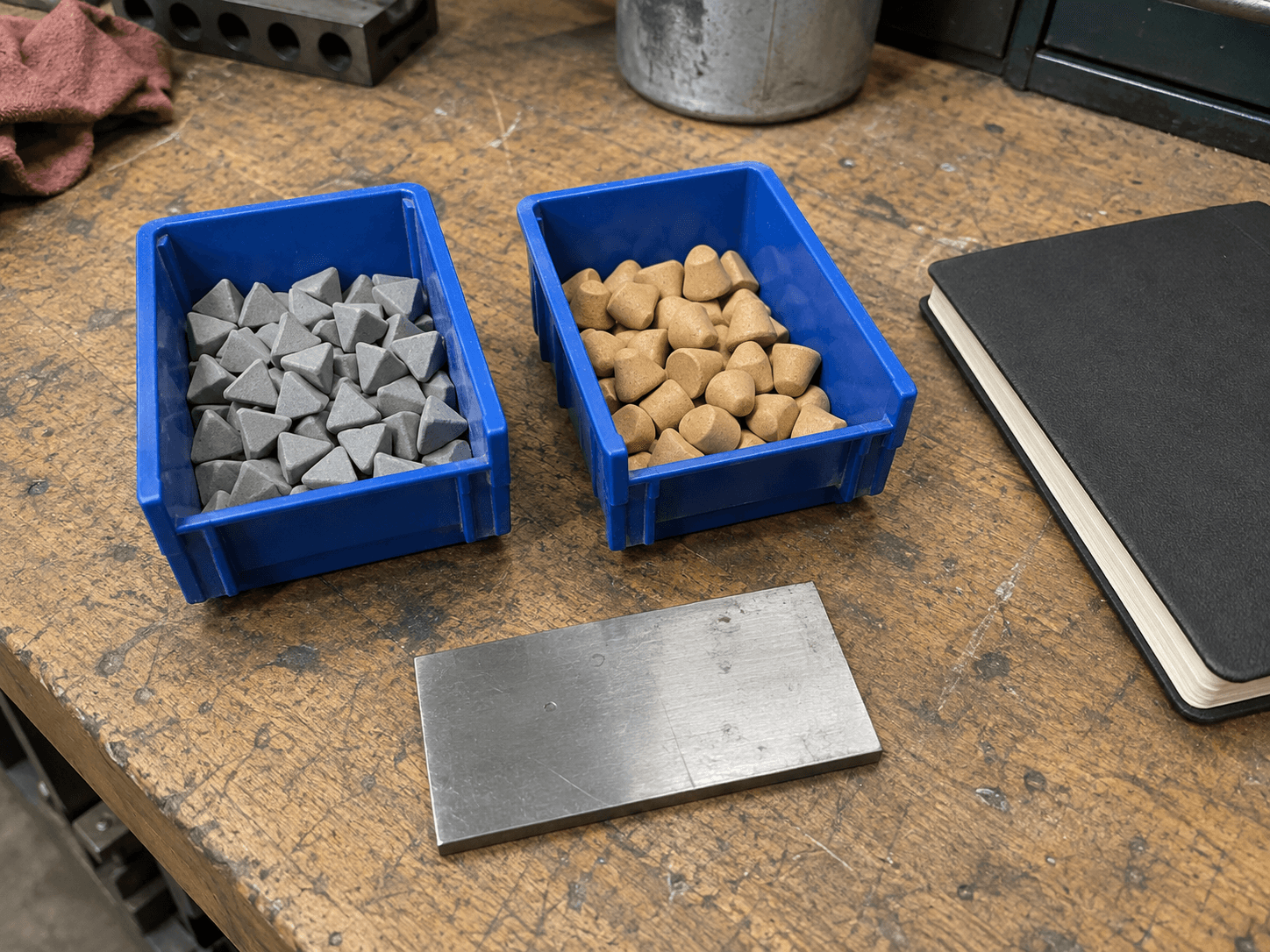
AI-generated conceptual illustration: two trays of generic finishing-media shapes beside a metal coupon on a workshop bench. Not Richwood products, customer parts or a measured comparison. Shapes, colors and quantities are illustrative, not selection specifications.
Plastic and ceramic are families, not cutting grades
Plastic finishing media contain abrasive grains in a resin bond. The word plastic does not mean non-abrasive. These media can remove material, so critical edges and dimensions still need checking.
Ceramic media also come in different formulations, from aggressive cutting grades to low-abrasion polishing grades. Ceramic is not automatically too aggressive for every aluminum part, and plastic is not automatically safe for every delicate feature.
Treat the material family as a starting point. Ask for the exact formulation and its suitability for your machine, part and finishing task. A familiar color or similar outline does not establish an equivalent grade.
Decide what the change must accomplish
If the current process already makes acceptable parts, write down why you want to change it. Are you trying to reduce marks, improve a surface before another operation, or solve a supply problem? Keep the existing accepted result as the comparison—not just a photograph of a shinier part.
Use this changeover checklist before choosing a trial setup:
| What to recheck | Why the old recipe may not transfer | What to confirm |
|---|---|---|
| Exact media grade | The material family does not specify the cutting action. | Supplier grade, intended application and machine suitability. |
| Working load | Different bulk densities mean equal weights need not occupy equal volumes. | Actual load volume and weight within the machine maker's limits; do not substitute pound for pound by assumption. |
| Shape and size | A new profile can reach, miss or lodge in different features. | Burr access and removal from holes, slots and recesses. |
| Compound and water | A media change is a reason to review the complete wet process. | Compatibility and operating guidance for the selected media, metal and machine. |
| Acceptance and separation | A better-looking surface alone does not establish a usable process. | Burr removal, protected features, finish requirements and complete media removal. |
Do not use a general density comparison as a fill formula. Bulk packing depends on the actual media and shape. Confirm the working charge with the equipment and media suppliers.
Run a comparison you can explain
Start with representative unfinished parts and an accepted finished reference. If a drawing, roughness requirement or edge limit controls acceptance, include it. A reference part helps communicate appearance; it does not replace those requirements.
Record the current media code, condition, load and settings. Then agree on a safe trial setup for the candidate media. Keep the starting parts and inspection method comparable, and document every setup change that is necessary. Do not preserve an unsuitable fill or setting merely to say that only one variable changed.
Check the actual burr location as well as the visible outside surface. Inspect protected features and verify that parts separate from the media. If the next step is plating, anodizing or assembly, include its acceptance needs in the comparison.
The question is not simply whether the new batch looks better. It is whether the complete process makes acceptable parts consistently enough for the intended work.
Questions worth settling before the first production batch
Can I keep the same cycle time?
Use the old time as a recorded baseline, not a promised setting for the new media. The selected formulation and operating conditions can change cutting behavior. Establish the required result through the trial rather than assuming plastic always needs a particular percentage more time.
Can I mix new plastic media into the ceramic charge?
Do not treat topping up as an automatic conversion. You would be evaluating a mixed charge, not a plastic-only process. Get a defined recommendation and record what is actually in the machine before drawing conclusions from the result.
Is plastic always the right choice for aluminum?
No. It is a useful candidate for many softer-metal and sensitive-surface applications, but the right answer depends on the alloy, geometry, burr and finish requirement. Both families contain different grades. Test the proposed grade on the part.
Bring the current process, not just the replacement request
When you contact Richwood, include the machine model, part material, current media code and dimensions, and what you want to improve. Add a part photo and identify the critical surfaces. Discuss representative unfinished parts and a finished reference before arranging a trial.
You can browse the media and compounds catalog for the available families. The useful next step is matching a candidate to your actual process—not ordering a different material family and hoping the old recipe transfers.