
The lower-priced bag is not necessarily the lower-cost finishing process. Compare media on representative parts, count only parts that meet the same acceptance requirements, and include media consumption, handling and rework. Price per pound matters, but it cannot tell you how much it costs to produce an acceptable part.
Start with the part: What material is it? What needs to come off? What must stay unchanged? Then compare the media and the process needed to get there.
Why this question matters now
An October 2, 2026 report in Process Engineering Control & Manufacturing describes DMM's comparative trials of plastic finishing media for aluminium carabiners and connectors. The supplier account reports improvements in finish, media consumption and processing time after a change in media.
That is a useful reason to review how you evaluate consumables. It is not evidence that changing media will deliver the same result on your parts. The reported application is not a Richwood project, and a supplier case study is not an independent head-to-head test.
The buyer's question is practical: does the alternative lower your cost while still meeting the requirements on your drawing and inspection plan?
Set the acceptance gate before comparing prices
Write down what a passing part looks like before the trial. Include burr removal, critical edges and dimensions, the required surface finish, and any cleaning or downstream-process requirements. Use an acceptable finished reference alongside the written requirements; appearance alone cannot replace measurements.
A faster cycle that leaves a burr is not a saving. Neither is a lower media bill that creates more sorting or touch-up work.
Media formulation, shape and size all matter. Two chips that look similar are not automatically interchangeable. Confirm their specifications and suitability for the machine, material and part features before comparing results.
Build a simple cost-per-accepted-part worksheet
For the trial period, divide the finishing costs you actually include by the number of accepted parts produced in that same period. Use the same accounting boundary for both options.
Finishing cost per accepted part = included finishing costs ÷ accepted parts.
This is a proposed comparison worksheet, not a Richwood price, savings estimate or guarantee.
| Cost or result | What to record for each option |
|---|---|
| Media consumed | Media added and removed, remaining usable charge, and purchase cost on the same basis. Do not charge a whole bag to a trial if most remains available for production. |
| Other process costs | Compound, water, energy and waste handling where measurable. Mark estimates as estimates and apply the same method to both options. |
| Operator work | Loading, unloading, separation, rinsing, drying, inspection and touch-up. Separate hands-on minutes from machine running time. |
| Accepted output | Parts meeting the agreed checks, plus rejects and rework. If rework cost is included, do not also count it a second time elsewhere. |
Keep one-time trial or changeover costs visible and separate from the expected recurring cost. Record machine occupancy too: a shorter cycle may release capacity, but it is not automatically a cash saving if the machine was not constraining production.
Compare qualified processes, not arbitrary settings
There are two different questions a trial can answer.
A controlled substitution: Does the candidate media work within the established process settings? Record any departures so you know what the result actually demonstrates.
A process comparison: What suitable combination of media, compound, loading and cycle gives an acceptable result for each option? If several variables change, call it a process comparison. Do not attribute the whole improvement to media alone.
Agree the trial approach with the process supplier. Keep part material, geometry, incoming condition and acceptance checks comparable. Use representative work, not an unusually easy batch. Repeat enough batches to see whether the result holds; one good part does not establish production consistency.
Media condition also matters. A fresh charge and a worn or contaminated charge are not equivalent starting points. Record the working mix and any supplier-recommended conditioning. Do not apply another machine's fill level, water flow or compound concentration as a universal recipe.
Check what happens after the timer stops
A candidate that finishes quickly can still be a poor fit if it lodges in features or makes separation difficult. Look at the parts after separation, cleaning and drying, not just when the machine stops.
Confirm that the proposed media can be identified and reordered by specification. Keep the supplier's product identification, formulation, shape and nominal dimensions with the trial record. A photograph is useful context, not a complete purchasing specification.
The decision is not simply which media cuts fastest or lasts longest. It is which qualified process delivers the required parts at a defensible recurring cost.
Bring the current process and the target result
Contact Richwood with your machine model, part material, current media specification, batch quantity and the result you need. Include where the work is slowing down and which acceptance checks are non-negotiable. Confirm sample arrangements before shipping parts.
You can review Richwood's finishing media range as a starting point. The useful next step is a parts-and-process discussion, not choosing a bag on price alone.
Supporting illustration
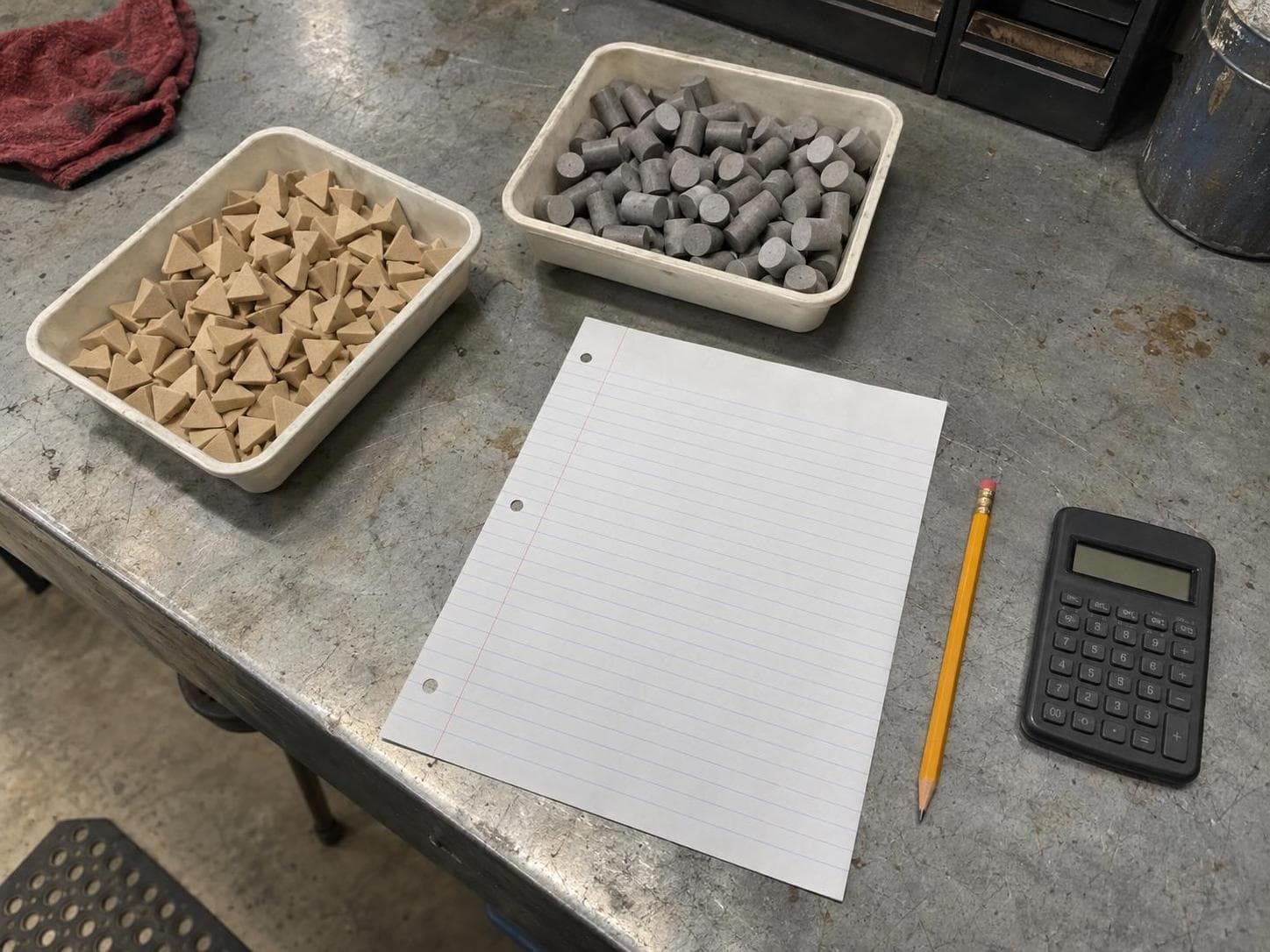
AI-generated conceptual illustration: generic finishing chips beside a blank worksheet and calculator on a workshop bench. Not a Richwood product photograph, supplier comparison, customer trial or measured result. The trays do not represent the media used in the reported DMM project.