
If the media in a vibratory finishing bowl circles the center but barely rolls over, check drainage, compound delivery and the load against the last successful setup. Flooding, unsuitable compound conditions or a changed load can interfere with useful motion. If the machine itself has developed abnormal vibration or noise, stop and have it checked before changing the process.
Start with this question: Did the motion change after a new batch, a refill or maintenance, or did it change with nothing intentionally different?
This guide concerns wet vibratory bowl finishing. It is not a setup recipe for a centrifugal barrel or disc machine.
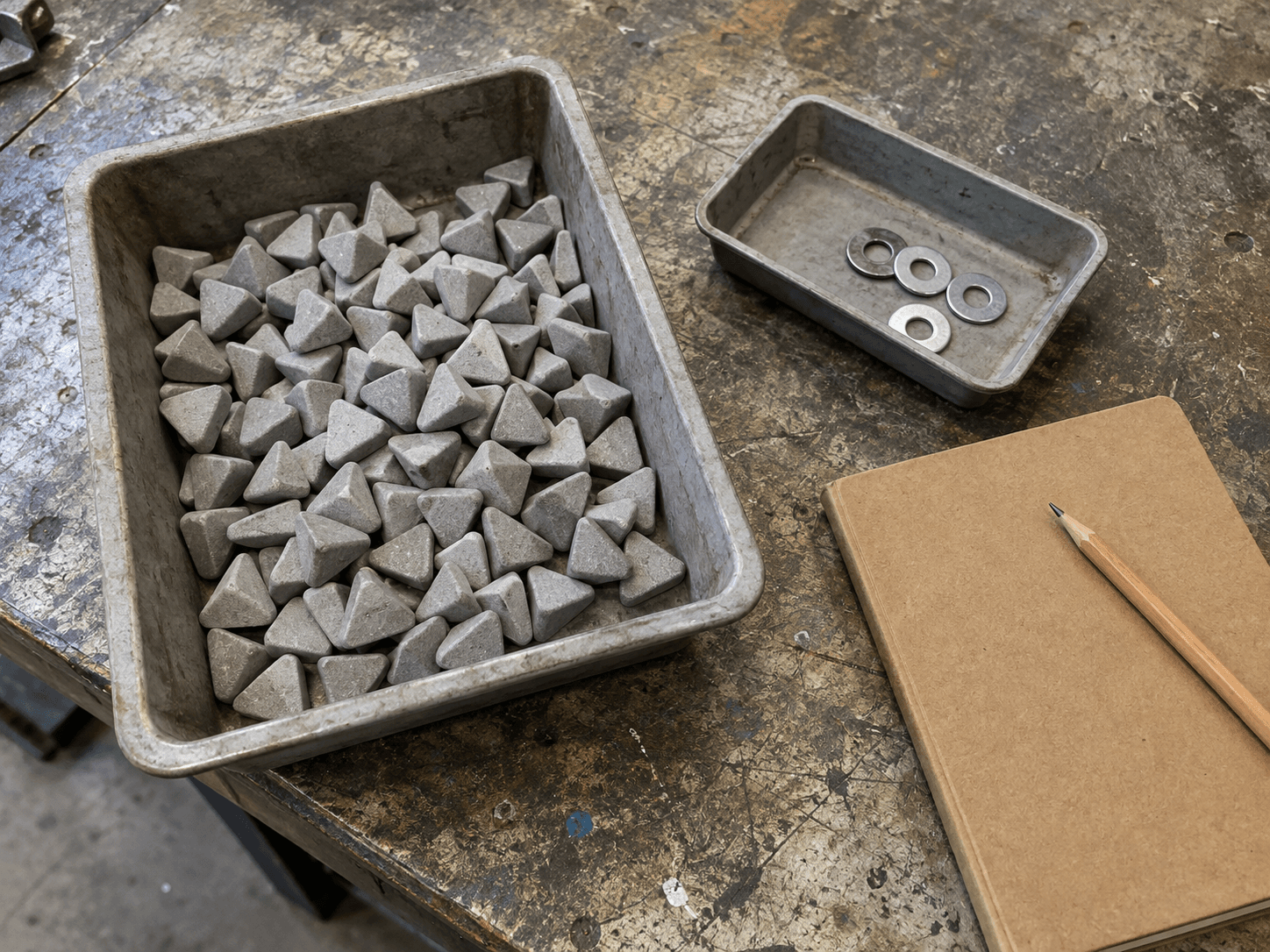
AI-generated conceptual illustration: separate trays of generic ceramic media and washers beside a notebook. Not Richwood equipment, customer parts, a recommended load ratio or diagnostic-test evidence.
Circling is not the same as rolling
A bowl can be visibly vibrating while the parts-and-media mass moves poorly. In normal operation, the required motion depends on the machine and its approved setup. Movement around the center alone does not establish that the media is turning over and contacting the parts as intended.
Describe what you see: a slow roll, a nearly stationary area, movement around the center without much turnover, or parts collecting in one place. Compare with the last good batch in the same machine, not an unrelated machine video.
A short video taken from a safe operating position can help explain the symptom. Keep guards and covers in their required positions; do not reach into the moving load to demonstrate it.
Separate process checks from machine checks
| What changed or what you see | What to establish next | What not to assume |
|---|---|---|
| More liquid remains in the bowl, or discharge has slowed | Check the specified drain path and actual incoming flow using the machine's inspection procedure. | More water always improves finishing. |
| Motion changed after a compound refill or dosing adjustment | Confirm the product, mixing method and actual delivery against the approved setup. | The dial setting proves the delivered concentration. |
| Motion changed after a media or part-load change | Compare media identity, fill level and part quantity with the successful load. | The same weight of a different media gives the same working load. |
| Unusual vibration, new noise or movement of the machine | Stop and refer the machine to qualified maintenance using its manufacturer instructions. | Turning up the vibration will correct the underlying fault. |
Do not inspect drains, springs, weights or other moving components while the machine is energized. Follow the machine's shutdown and your plant's lockout procedure for hands-on work.
Check the liquid path before adding more compound
For a flow-through bowl, the incoming solution must be able to leave through the intended drain path. A restriction can leave the mass flooded even though the supply setting has not changed. Excess liquid can dampen the activity you are trying to restore.
Check actual flow and drainage against the established process. Also verify the compound product and dosing system. Excessive concentration or the wrong compound can make the mass too slippery or contribute to foam, but appearance alone does not identify the chemistry.
There is no universal concentration or flow setting for an unidentified bowl, media and part. Use the approved process and current supplier instructions. Do not dilute by guesswork or use skin contact as a concentration test.
If foam is the main symptom, use the separate excessive-foam troubleshooting guide. Eliminating bubbles is not, by itself, proof that the finishing process is restored.
Check the load before changing the drive
Write down the media code and shape, its condition and fill level, the part quantity, and any recent additions. A media change can alter how the mass moves. Adding more parts can also change the working load, even when everything still fits inside the bowl.
Return to the approved loading information for that machine and job. Do not borrow a fill percentage or parts-to-media ratio from a different process. The machine-capacity guide explains why physical space alone is not a production-capacity limit.
If the process checks do not explain the change, get the machine condition checked. Mounting, springs, drive components and the lining belong in a manufacturer-specific maintenance assessment. Do not loosen eccentric weights or improvise a drive adjustment from a general article. For lining condition, see when to reline a vibratory finishing bowl.
A restored roll still needs an accepted part
Useful motion is one process observation, not the acceptance standard. After an authorized correction, check burr removal, critical edges, dimensions, surface condition and cleanliness against the job's requirements.
Do not simply extend the cycle to compensate for unexplained poor motion. Record the changed factor and the resulting part checks. Where practical, change one factor at a time. Keep the final approved setup in the mass-finishing process record.
What to include in a process inquiry
Contact Richwood with the machine make, model and size; part material and quantity; media and compound identification; and how the solution enters and leaves the bowl. Explain what changed, when the motion changed, and which part requirement is no longer being met.
Include a safe video if available and a reference for the finish you need. Those details make the first conversation more useful than “the bowl isn't working.”