
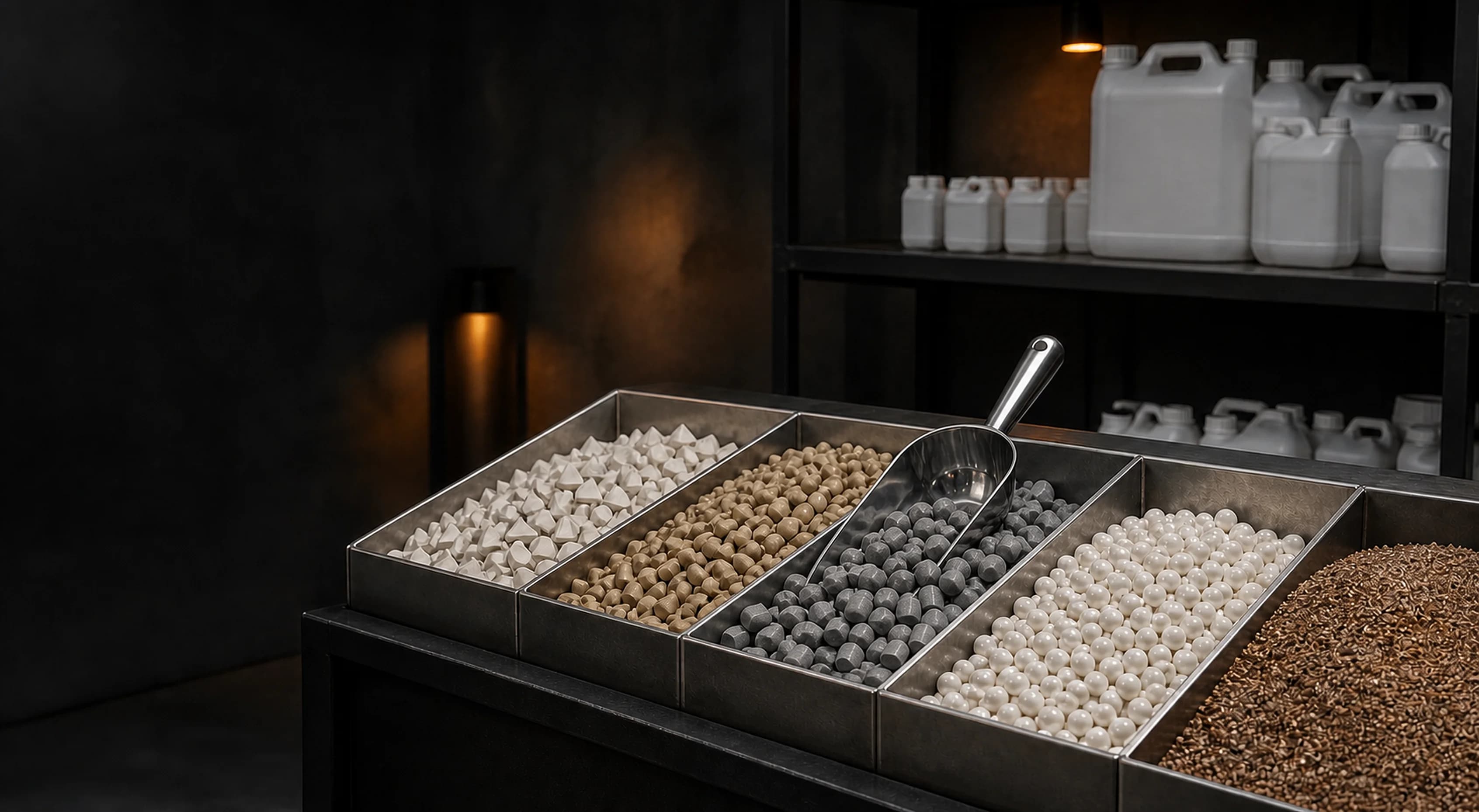
Use ceramic media to deburr and cut steel, stainless, and titanium. Use plastic media on aluminum, brass, zinc, and any part headed for plating. Use porcelain or steel media when you want a bright burnished surface rather than a cut. Match the shape to the part and the size to the smallest feature the media has to reach and still separate from.
That is the short version. The rest of this guide is the reasoning, so you can pick media for a part we have never seen. Every type below is priced per pound and in stock in Los Angeles on the media and compounds catalog.
Start with the material of the part
| Part material | First choice | Why |
|---|---|---|
| Steel, stainless, tool steel | Ceramic | Dense and abrasive. Cuts hard metal fast and wears slowly. |
| Titanium, Inconel, hardened alloys | Ceramic, fast-cut grade | Hard metal needs the most aggressive cut you can protect the part with. |
| Aluminum, brass, zinc, copper | Plastic or polyester | Lighter and softer. Deburrs without peening, denting, or embedding. |
| Parts going to plating or anodizing | Plastic, then porcelain | Plastic gives a uniform matte base. Porcelain brightens without cutting. |
| Parts that need a bright finish | Porcelain or steel | Non-abrasive. They burnish the surface instead of removing metal. |
| Dry polish, drying, final gloss | Hardwood or organic | Runs dry, absorbs moisture, brings up shine. |
| Heavy stock removal | XM and XA abrasive nuggets | The most aggressive cut in the catalog. For tough parts only. |
Then match the shape to the geometry
Media shape decides which surfaces get worked and whether the media gets stuck.
- Angle-cut cylinders and triangles reach into corners, slots, and bores. The angled face presents an edge to the work.
- Cones and tristars work flat faces and edges evenly and roll well in a packed bed.
- Spheres and balls burnish and polish without lodging. Good for porcelain and steel.
- Pyramids and wedges get into tight internal geometry that a cylinder cannot.
The rule: if the part has a hole, a slot, or a recess, choose a shape that can enter it and leave it. Our product pages carry the dimensions of every shape in inches and millimeters, with a 3D model you can rotate.
Then size it to the smallest feature
Two tests. First, will the media reach the smallest feature you need finished? Second, will it separate cleanly from the part afterward? Media close to the diameter of a hole will lodge in it. Media close to the thickness of the part will fall through the separator screen with the part. Run the largest size that passes both tests, because larger media cuts faster.
If your parts and media are close in size, a media separator on the machine pays for itself in the first month.
Compound is not optional
Compound does three jobs: it keeps the media cutting instead of loading up, it carries metal fines out in the water, and it keeps parts from tarnishing or rusting between cycles. Richwood numbered compounds are matched to the media and the metal. A deburring compound for steel and a burnishing compound for brass are different chemistry. Use the one the recipe calls for, at the dose it calls for, and change the water when it clouds.
What it costs
| Media | Price per pound |
|---|---|
| Ceramic | $3.25 |
| Plastic and polyester | $3.25 |
| Porcelain | $5.00 |
| Hardwood and organic | $2.00 |
| Steel | $10.00 |
| XM and XA abrasive nuggets | $10.00 |
| Compounds | $6.00 |
Volume pricing is by quote. Discount codes for repeat customers absorb the rest. The full catalog with stocked sizes is on the media page.
The centrifugal barrel difference
At up to roughly 25 G, media in a centrifugal barrel does the work of hours in a vibratory bowl in minutes. That also means media wears faster and a mismatch shows up faster. A plastic media that is fine in a bowl may be too soft for a high-energy cycle. A ceramic that is right for steel will peen aluminum in a barrel. When you move a process from vibratory to centrifugal, retest the media. Do not assume.
Test it before you buy a pallet
Send us the part and tell us the finish you need. We run it in the actual machine with the media we would recommend, write down the recipe, and send the part back. If the recipe works, the same media ships with the machine as a $950 starter kit, or on its own for a machine you already own. Start a sample test or request a media quote.
Common questions
What tumbling media should I use in a centrifugal barrel?
Ceramic for deburring and cutting steel, stainless, and titanium. Plastic for aluminum, brass, zinc, and pre-plate work. Porcelain or steel for a bright burnished finish. Match shape to geometry and size to the smallest feature.
What is the difference between ceramic and plastic media?
Ceramic is dense and abrasive: faster cut, longer life, best on hard metals. Plastic is lighter and softer: gentle cut, smooth matte surface, no peening on soft metals.
How do I choose media size?
Pick the largest size that reaches the smallest feature and still separates cleanly from the part. Media that can lodge in a hole or match the part's thickness will cause trouble at the separator.
How much does tumbling media cost?
Per pound at Richwood: ceramic $3.25, plastic and polyester $3.25, porcelain $5.00, hardwood $2.00, steel $10.00, XM and XA nuggets $10.00, compounds $6.00. Volume pricing by quote.