
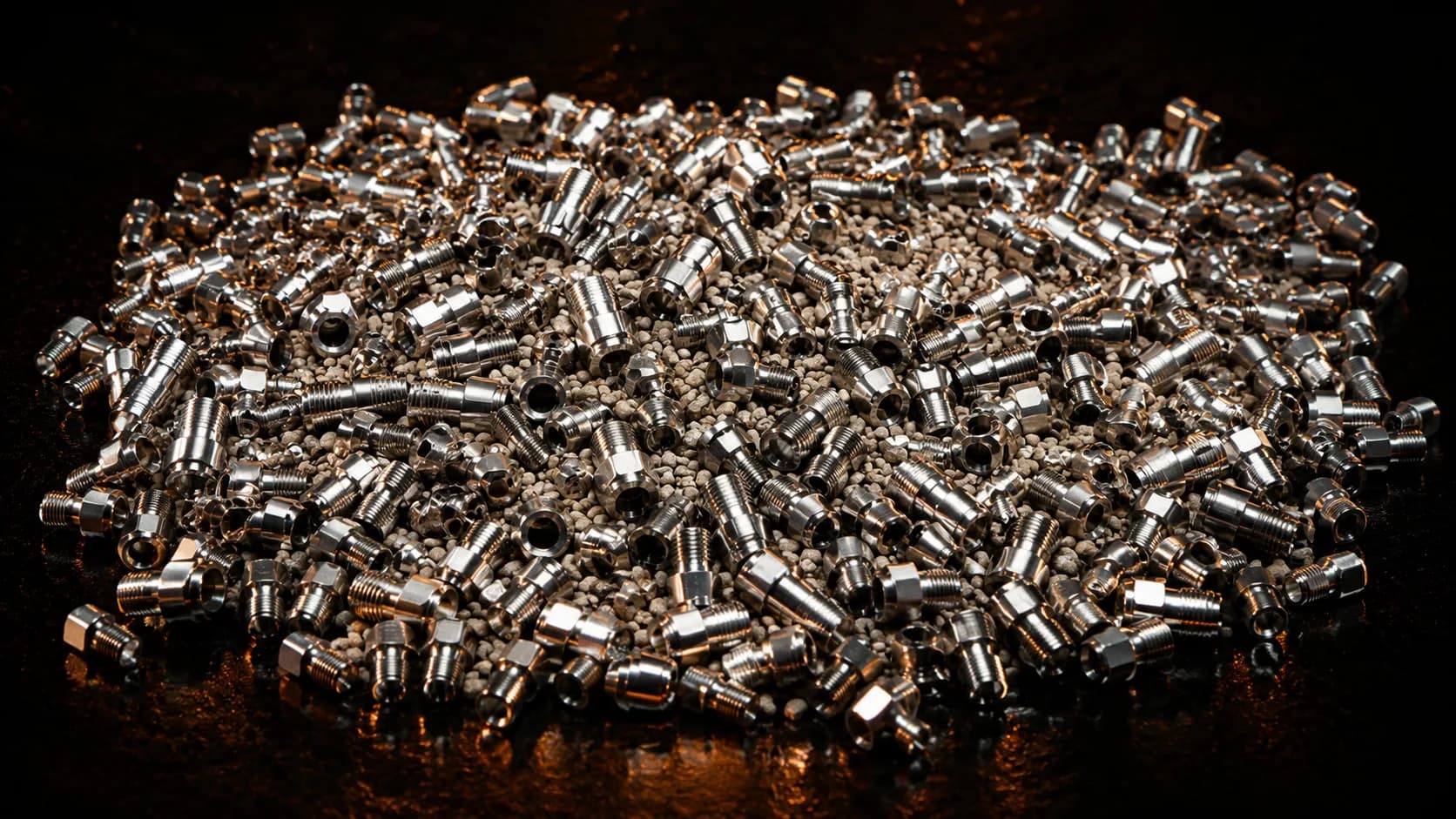
Feed lips, followers, floor plates, locking plates, and guide rails all need a clean, consistent edge on every unit, because a burr on a feed lip is a failure to feed. Centrifugal barrel finishing deburrs and edge-breaks these stamped and machined parts in minutes, works every edge in every direction, and gives the same result on the ten thousandth part as on the first. That repeatability is what mil-spec acceptance is really asking for.
This is a process guide for shops making magazines, ammunition components, and small-arms parts. It does not name customers. The setup is the same whether you make fifty magazines a week or five thousand.
Why hand deburring fails here
A skilled operator can deburr one feed lip well. Across a shift, the results drift. Fatigue, a worn file, a new hire, or a fast day all change the edge. On a part where the edge is the function, that drift shows up as a reject at final inspection or, worse, as a stoppage in the field.
Mass finishing removes the operator from the edge. Every part in the barrel sees the same media, the same force, and the same time. The variance goes away.
What the barrel does to a stamped part
Stamped sheet metal leaves a burr on the die-break side and a rollover on the punch side. Machined parts leave burrs at every edge the tool exited. In a centrifugal barrel, the packed, sliding bed of media presses against the part at up to roughly 25 G. It removes the burr, breaks the edge to a small uniform radius, and leaves an isotropic surface with no directional tool marks. On a feed lip, that means a smooth radius the cartridge slides over. On a follower or floor plate, it means a clean edge that does not catch the spring or the body. The how it works page explains the mechanics.
Setting up the process
Keep the parts apart. Thin stamped parts will nest and scratch if they are free to touch. The compartment dividers in the RW-120 and RW-220 keep parts in their own space. For smaller lots, the removable barrels on the CV8-600 do the same job.
Size the media so it cannot lodge. Feed lip radii, spring windows, and witness holes are traps for media. Choose a shape and size that cannot enter them, or that enters and leaves freely. Angle-cut ceramic cylinders and small triangles are the usual starting point on steel. Plastic media on aluminum floor plates and followers. Our media selection guide covers the choices.
Match the compound to the coating that follows. Most magazine bodies go to a finish afterward, whether that is phosphate, a polymer coating, or anodizing. A clean, uniform, slightly matte surface out of the barrel is the base those coatings want. Use a compound that leaves the part clean and rust-free until it gets there.
Prove the cycle on real parts. Deburring a steel magazine body usually runs 15 to 45 minutes. Aluminum followers run shorter with plastic media. The number that matters is yours, and you get it by running your parts, not by reading a page.
Repeatability, in practice
Write the recipe down: machine, barrel, media type and size, compound, water, load per compartment, turret speed, and time. Run it the same way every lot. Inspect to your acceptance standard, not to how the part looks. The finishing step then becomes a fixed, documented operation in your traveler instead of a skill that lives in one person's hands.
Related parts that run the same way
Bolt carriers, extractors, ejectors, trigger components, sights, and small machined receivers all benefit from the same process, with the media and cycle adjusted for the material and the feature size. The defense and precision components page covers the wider family.
Lead time
Most vendors in this category build to order and quote around 90 days. Richwood keeps machines in stock in Los Angeles and ships in about one week, which matters when a contract award lands and the finishing step is the one thing standing between you and the first delivery. Current inventory is on the in-stock page.
Prove it on your parts first
Send us a feed lip, a follower, and a floor plate. We run them in the actual machine, write down the recipe, and send them back so your quality team can inspect the edge. Start a sample test.
Common questions
What is the best way to deburr firearms magazine components?
Centrifugal barrel finishing. It works every edge in every direction at up to roughly 25 G, in minutes, with the same result batch after batch.
Can it meet mil-spec consistency requirements?
It removes operator variance, the usual cause of inconsistent hand deburring. Every part sees the same media, force, and time. Acceptance and qualification stay with your quality system.
Will tumbling damage thin stamped parts?
Not when the barrel is set up correctly. Dividers keep parts apart, media is sized so it cannot lodge, and the cycle is proven on sample parts first.
How fast can we get a machine?
Richwood ships in-stock machines from Los Angeles in about one week. Most vendors quote around 90 days.